
Tech professionals often compare EB-2 NIW vs O-1 visa because both can help strong candidates build a future in the U.S. But they solve different problems. The O-1 is a temporary work visa for individuals with extraordinary ability, while the EB-2 NIW is an immigrant green card petition for professionals whose work benefits the U.S. national interest. USCIS describes O-1 as a nonimmigrant visa for people with extraordinary ability or achievement, while EB-2 NIW sits under the employment-based second preference green card category.
Before comparing speed, it is important to understand what each path is designed to do. The O-1 visa and EB-2 NIW are both useful for strong tech profiles, but they serve different immigration goals and are judged under different standards.
The O-1 visa for extraordinary ability is designed for people who can show a high level of achievement in their field. For tech professionals, this may include AI engineers, startup founders, cybersecurity experts, senior software engineers, product leaders, data scientists, and technical executives.
The O-1 visa for tech professionals can be powerful when the applicant has strong proof of recognition. This may include major roles at respected companies, technical awards, published media, patents, judging work, open-source impact, high compensation, or original contributions.
The EB-2 NIW green card is different from the O-1 visa. It is not just permission to work temporarily. It is a green card route for professionals who qualify under EB-2 and can show that waiving the job offer and labor certification requirements benefits the United States.
EB-2 NIW for tech professionals can work well when the applicant’s work has broader importance, such as AI infrastructure, cybersecurity, healthcare technology, climate technology, semiconductor systems, robotics, fintech infrastructure, or advanced research.
The easiest way to understand O-1 vs EB-2 NIW is this: O-1 asks whether you are extraordinary in your field. EB-2 NIW asks whether your proposed work has national importance and whether you are well-positioned to advance it.

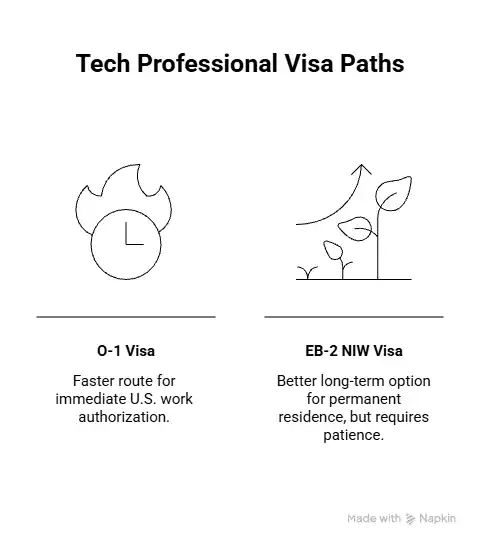
If the goal is to start working in the U.S., O-1 is usually the faster route. If the goal is permanent residence, EB-2 NIW may be the better long-term option, but it usually requires more patience.
If your goal is to work in the U.S. soon, the O-1 is usually the fastest practical path. This is why many people looking for the fastest U.S. visa for tech professionals compare O-1 first.
O-1 petitions are filed on Form I-129, and eligible I-129 petitions may use premium processing. USCIS lists premium processing timeframes for eligible classifications, including 15 business days for many covered petitions.
That does not mean approval is easy. Premium processing only speeds up government review. It does not reduce the legal standard.
EB-2 NIW can be faster than employer-sponsored green card routes because it avoids PERM and does not require a specific job offer. But it is still a green card process.
Even if the I-140 petition is approved, some applicants may still need to wait for visa availability depending on their country of birth. That is why EB-2 NIW can be excellent for long-term planning but may not be suitable for an urgent or short-term U.S. work authorization problem.
If you need to start working in the U.S. soon, an O-1 is usually faster. If you want permanent residence, EB-2 NIW may be the better long-term route. For many tech professionals, EB-2 NIW vs O-1 visa is not an either-or decision. The stronger strategy may be to apply for an O-1 first, then a green card petition later.
Both options are evidence-heavy, but the evidence is not the same. O-1 focuses more on recognition and extraordinary ability, while EB-2 NIW focuses more on the importance of your proposed work and your ability to advance it.
A strong O-1 case usually needs evidence that proves you stand out in your field. For tech applicants, this may include:
Awards, competitive recognition, press coverage, published technical work, patents, major product contributions, judging or peer review, high salary, leadership roles, venture funding, open-source adoption, or proof that your work created measurable business or technical impact.
Learn more in detail from Beyond Borders’ guide to O-1 visa extraordinary ability evidence.
EB-2 NIW evidence is different. It should show that your proposed work has substantial merit and national importance, that you are well-positioned to advance it, and that waiving the job offer and labor certification requirements benefits the U.S. USCIS policy guidance explains that NIW applicants must first qualify under EB-2 and then meet the national interest waiver standard.
Useful evidence may include publications, patents, product adoption, grants, expert letters, technical leadership, startup traction, revenue, customer impact, government or enterprise relevance, and proof that your work addresses an important U.S. need.
For many tech professionals, applying for an O-1 visa first can be the best strategy when timing is critical. It can help you enter or stay in the U.S. for work while you continue building a stronger long-term green card strategy.
Applying for O-1 first is better if you have a U.S. role, founder opportunity, client project, advisory position, or investor-backed startup plan that needs near-term execution.
If your profile already includes press, awards, technical leadership, judging, high salary, notable employers, publications, or strong original contributions, O-1 may be the cleaner first move.
O-1 can also support an O-1 visa to green card plan. While working in the U.S., you may continue building evidence for an EB-2 NIW or O-1 to EB-1A green card strategy.
EB-2 NIW may be the better route when your long-term goal is a green card, and your work has a strong national interest argument. This is especially relevant for professionals working in fields like AI, cybersecurity, health tech, robotics, energy, climate technology, and advanced infrastructure.
EB-2 NIW is stronger when the main goal is a green card, not just temporary work authorization.
This route may fit tech professionals working in areas like AI safety, healthcare innovation, cybersecurity, infrastructure, defense technology, climate systems, robotics, education technology, or advanced manufacturing.
EB-2 NIW is especially useful for founders, independent researchers, consultants, and senior technical professionals who want a self-petition route instead of relying on employer sponsorship. It is generally a safer route as you won’t be dependent on employer sponsorship to stay in the U.S for the long term.
Yes. Many professionals pursue both paths when the facts support it. O-1 may help with faster U.S. work authorization, while EB-2 NIW supports permanent residence planning.
For Indian and Chinese professionals in particular, this can be important because green card timing may be affected by visa backlogs. It is important to keep updated with the monthly visa bulletin. O-1 can provide a practical work pathway while the green card strategy develops.
The EB-2 NIW vs O-1 visa choice depends on what you need first. If you need faster U.S. work authorization and have strong recognition-based evidence, O-1 may be the better first step. If your goal is permanent residence and your work has clear U.S. national importance, EB-2 NIW may make more sense.
For many tech professionals, the smartest path is not choosing one forever. It is using O-1 for speed and EB-2 NIW or EB-1A for long-term stability.
Beyond Border helps founders, engineers, researchers, and technical leaders compare O-1, EB-2 NIW, and green card strategies based on their actual evidence and timeline.
Usually, no. O-1 is often faster if the goal is to work in the U.S. soon. EB-2 NIW is a green card petition, so it may involve longer timelines and visa availability issues.
Yes. Many tech professionals use O-1 for near-term work authorization and EB-2 NIW for long-term permanent residence planning.
O-1 may be better if the founder has strong recognition, traction, funding, press, or major technical contributions. EB-2 NIW may be better if the startup’s work has clear U.S. national importance.
No. O-1 does not automatically lead to a green card, but it can support a later EB-2 NIW or EB-1A strategy if the applicant continues building strong evidence.

Camila is the Head of Legal at Beyond Border, where she specializes in O-1, EB-1A and EB2-NIW visas. Camila is an OAB-certified lawyer, with 8 years of relevant US immigration experience. Camila has personally secured approval more than 100 O-1, EB-1A and EB2-NIW cases and maintained a perfect approval track record so far. Camila holds a Master's degree in Law from the Universidade Catolica Portuguesa, and is a sought after voice in the U.S. extraordinary alien visa field in press including Times of India.
Address: 4 W 4th Ave, San Mateo, CA 94402, United States
Email: info@beyondborderglobal.com