
An EB-2 NIW RFE can feel stressful, but it is not the same as a denial. It means USCIS needs more evidence before making a decision whether your petition qualifies for the National Interest Waiver (NIW) or not. The most important thing is to respond with precision, and you don’t need to panic.
An EB-2 NIW RFE is a formal Request for Evidence from USCIS. It asks the petitioner to submit additional documents, explanations, or clarifications before USCIS makes a final decision. USCIS may issue an RFE when required evidence is missing, unclear, outdated, or not strong enough to support eligibility.
An RFE means USCIS is still reviewing the case. It does not approve or deny the petition by itself. However, the response matters. A weak or incomplete EB-2 NIW request for evidence response can lead to denial.
For NIW cases, USCIS evaluates whether the applicant qualifies for EB-2 and whether the national interest waiver should be granted. The NIW test comes from Matter of Dhanasar and focuses on three points. These are the proposed endeavor’s merit and national importance, whether the applicant is well-positioned, and whether waiving the job offer and PERM requirement benefits the United States.
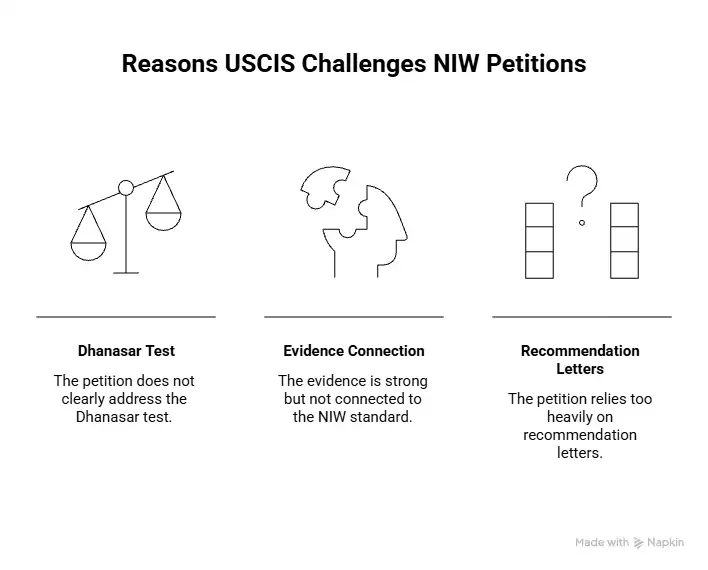
Most RFEs do not happen because the applicant lacks talent. They happen because the petition does not clearly explain why the applicant’s work meets the NIW legal standard.
A petition may include a strong resume, but if the evidence is not mapped to the three Dhanasar prongs, USCIS may challenge it. Officers need to see how each document supports eligibility.
Degrees, publications, awards, and senior job titles can help an EB-2 NIW petition, but they are not enough on their own. USCIS looks at how those achievements connect to the applicant’s proposed endeavor and why that work matters to the United States. For example, a software engineer may have an impressive background, but the petition still needs to explain how their technical work creates broader value beyond one employer or project.
This is especially important for applicants applying through role-specific pathways such as EB-2 for business owners, EB-2 NIW for developers, EB-2 NIW for STEM professionals, or EB-2 NIW for industry professionals, where the evidence must be framed around both professional expertise and national interest.
Letters can support a case, but they should not carry the whole petition. USCIS often wants objective proof, such as citations, grants, implementation records, business traction, contracts, patents, media coverage, or measurable industry impact.

Weak NIW national importance evidence is one of the most common reasons for an EB-2 NIW RFE. USCIS wants to know why the work matters beyond the applicant’s personal career or one employer’s business need.
A high salary, senior role, or strong education may show ability, but national importance requires more. The petition should explain the broader problem the applicant addresses and why solving it is important to the United States.
If the petition reads like a normal job application, USCIS may ask why the applicant needs an NIW instead of employer sponsorship. This is a frequent issue for consultants, founders, and business owners.
Strong evidence may include industry reports, government priorities, adoption by multiple organizations, job creation, public health relevance, cybersecurity impact, climate or energy value, educational outcomes, or measurable economic benefits. Business applicants should also review Beyond Borders’ guidance for EB-2 NIW business owners.
A weak EB-2 NIW proposed endeavor can trigger serious questions. USCIS does not just want to know what you do. It wants to know what specific work you plan to advance in the United States.
“I will work in AI” is too vague. A stronger version explains the exact AI use case, target sector, problem, expected users, and broader U.S. benefit.
A proposed endeavor should not simply list employment duties. It should describe a focused body of work with broader value beyond one job.
USCIS may question the case if the proposed endeavor is disconnected from the applicant’s past work, education, publications, business activity, or technical achievements.
Applicants often confuse these terms, but they are not the same.
For applicants comparing timelines after approval, read Beyond Borders’ guide on EB-2 visa waiting times by country.
For broader eligibility planning, see the EB-2 green card requirements, process, and timeline guide.

A strong USCIS RFE response does not simply resend the same petition. It rebuilds the argument around the officer’s concerns.
Break the RFE into separate issues. Each USCIS concern should have a direct answer, supporting evidence, and a short legal explanation.
Do not submit random documents just to make the response look bigger. Add evidence that fixes the exact weakness. This may include updated publications, expert letters, contracts, revenue records, product adoption, policy reports, grants, or proof of field-level use.
The response should clearly explain how the record satisfies each prong. If USCIS questions the national importance, do not only add more biography. Show broader impact. If USCIS questions whether you are well-positioned, show execution capacity.
For related RFE planning, Beyond Borders’ article on how to respond to an I-485 RFE is useful for understanding response organization, even though I-485 RFEs involve a different stage of the green card process.
Some applicants should consider O-1 while pursuing or preparing EB-2 NIW. This is especially relevant if the applicant already has strong recognition evidence but needs a faster temporary work pathway.
O-1 may fit founders, researchers, developers, executives, and specialists with evidence such as awards, press, judging, original contributions, critical roles, high salary, or published work. It does not replace the green card, but it can support a broader U.S. immigration plan.
An O-1 petition can help organize evidence of recognition while the applicant continues building a stronger EB-2 NIW or EB-1A profile. For some people, this is more practical than waiting without a U.S. work option.
An EB-2 NIW RFE should be treated as a serious warning, not a disaster. The best responses are focused, evidence-backed, and legally organized. They do not flood USCIS with documents. They answer the exact concern.
If your petition has been challenged, Beyond Border can help assess the RFE, identify the weak points, and build a response strategy around the NIW standard.
An EB-2 NIW RFE is a USCIS request for more evidence before deciding your National Interest Waiver petition. It usually means USCIS needs clearer proof of eligibility, national importance, your proposed endeavor, or your ability to advance the work.
No. An RFE is not a denial. However, a weak response can lead to denial if it does not directly fix the issues USCIS raised.
Common EB-2 NIW denial reasons include weak national importance evidence, a vague proposed endeavor, poor connection to the Dhanasar standard, limited independent evidence, and failure to show that waiving PERM benefits the United States.
Read the RFE carefully, separate each USCIS concern, add targeted evidence, and explain how the updated record satisfies the NIW standard. A strong response should be structured like a legal brief, not a document dump.

Camila is the Head of Legal at Beyond Border, where she specializes in O-1, EB-1A and EB2-NIW visas. Camila is an OAB-certified lawyer, with 8 years of relevant US immigration experience. Camila has personally secured approval more than 100 O-1, EB-1A and EB2-NIW cases and maintained a perfect approval track record so far. Camila holds a Master's degree in Law from the Universidade Catolica Portuguesa, and is a sought after voice in the U.S. extraordinary alien visa field in press including Times of India.

Address: 4 W 4th Ave, San Mateo, CA 94402, United States
Email: info@beyondborderglobal.com