Key Takeaways About Priority Dates and Visa Bulletin 2026:
»
Your priority date is your place in the green card queue, and it appears on the Notice of Action (Form I-797) for the petition filed on your behalf.
»
For employment-based cases, the priority date is the earlier of the date your PERM labor certification was accepted by the Department of Labor or the date USCIS received your I-140 petition.
»
Your date is current only when it is earlier than the cutoff listed for your category and country of birth in the controlling chart of the monthly Visa Bulletin.
»
The bulletin has two charts, Final Action Dates and Dates for Filing, and USCIS announces each month which one adjustment applicants may use.
»
Beyond Border attorneys have collectively handled 4,000+ immigration cases and will tell you plainly whether a retained priority date plus a stronger category, such as EB-1A or EB-2 NIW, can shorten your wait.
The official check takes under a minute, and you don’t need a third-party tracker or calculator. If you hold an approved I-140 and were born in India or China, you can check your priority date using the visa bulletin as published by the Department of State and USCIS, and this guide shows you exactly how to read it.
Beyond Border attorneys have collectively handled 4,000+ immigration cases across employment-based categories. The walkthrough below reflects how our attorneys check visa availability for clients, and if your date looks stuck, you can request an honest assessment of the faster-category options at the end of this article.
What Is a Priority Date, and Where Do You Find Yours?
Your priority date determines your place in the immigrant visa queue. Which date becomes your priority date depends on how your case started.
For PERM-based cases (most EB-2 and EB-3), your priority date is the date the Department of Labor accepted your permanent labor certification for processing, not the later date your employer filed the I-140.
For self-petitions and no-PERM cases (EB-1, EB-2 NIW), your priority date is the date USCIS received the I-140 petition, shown on your I-797C receipt notice.
Many EB-2 and EB-3 applicants check the wrong date. If your PERM was filed months before your I-140, your priority date is earlier than the receipt notice suggests, and your position in the queue is better than you think. Pull your I-797 now and confirm which date applies to your case before running the check below.
Scroll to the employment-based table for the chart you identified in step 2 and find your preference category row (EB-1, EB-2, EB-3, or Other Workers).
Read across to your country-of-chargeability columns. This is your country of birth, not citizenship or residence.
Compare the two dates. The bulletin authorizes numbers "only for applicants whose priority date is earlier than the final action date listed." A "C" in your cell means current for everyone in that category; a "U" means no numbers are available.
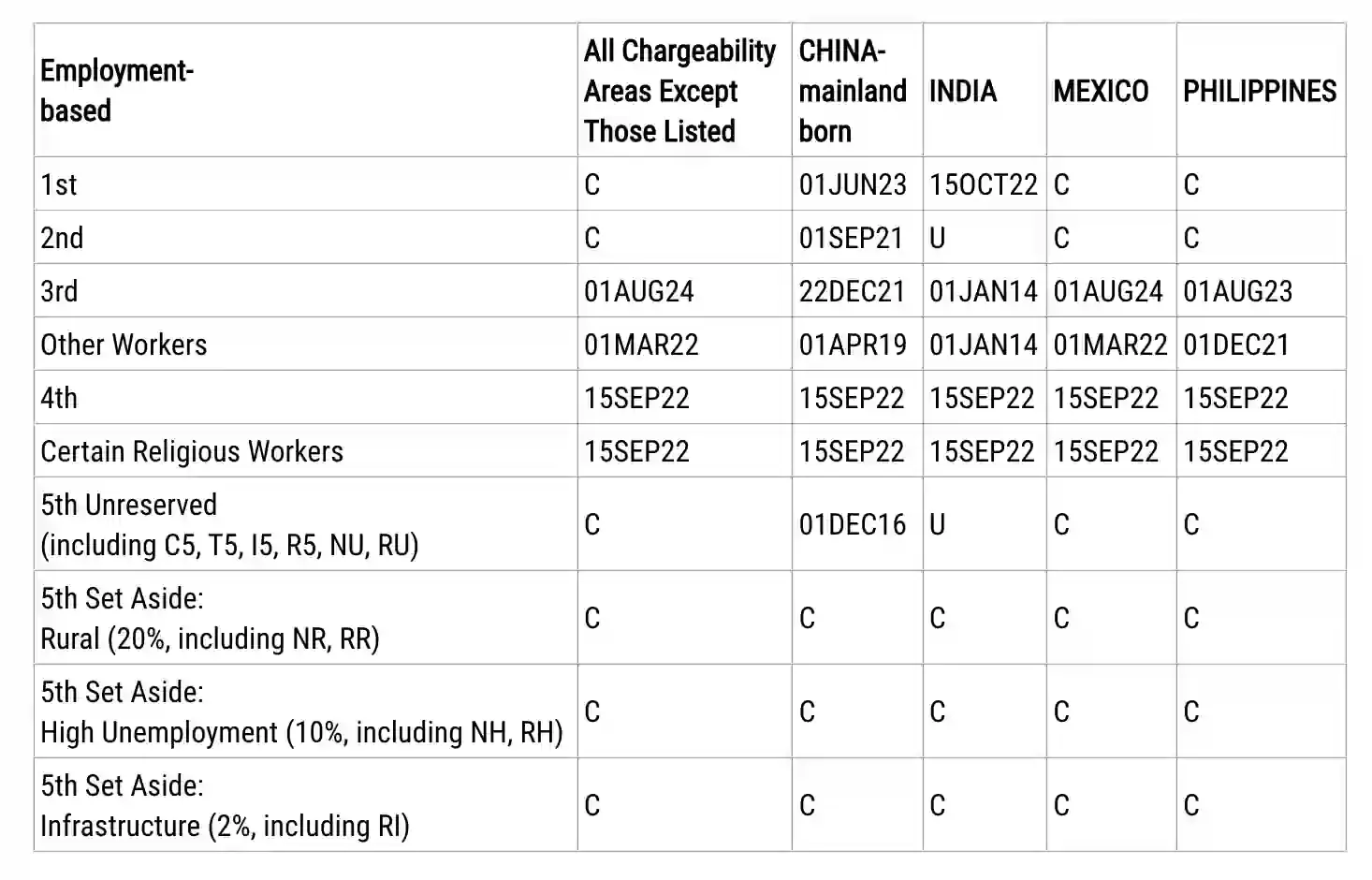
Here’s a practical example using the employment-based Final Action Dates chart from the July 2026 Visa Bulletin. These figures expire when the August bulletin is published; treat them as a worked example.
In practice, an India-born EB-1 applicant with a priority date of March 2022 is current as of July 2026 and can move to the next stage of their application because March 2022 is earlier than 15 October 2022.
A September 2013 EB-2 India applicant is not current because the category shows "U,” which means it’s unavailable.
EB-2 India became unavailable because India's prorated share of the annual EB-2 limit has been exhausted for the 2026 fiscal year. EB-1 India also moved backwards in July 2026 for the same reason. DOS has also mentioned that the EB-2 India date will likely advance in October when the fiscal year 2027 supply opens.
Final Action Dates vs Dates for Filing
The bulletin publishes two charts each month, and they mean different things;
Final Action Dates
Dates for Filing
What it governs
When a green card can be approved and an immigrant visa number
can be issued
When you may submit your application package before the date
when final approval becomes available
Inside the US (Form I-485)
Always controls final approval. It also controls filing unless
USCIS designates the Dates for Filing chart for that month
Controls filing only in the months when USCIS designates the
Dates for Filing chart
Outside the US (consular processing)
Governs when the case can be scheduled for final action
Governs when the National Visa Center may request supporting
documents
What it governs
Final Action Dates
When a green card can be approved and an immigrant visa number
can be issued
Dates for Filing
When you may submit your application package before the date
when final approval becomes available
Inside the US (Form I-485)
Final Action Dates
Always controls final approval. It also controls filing unless
USCIS designates the Dates for Filing chart for that month
Dates for Filing
Controls filing only in the months when USCIS designates the
Dates for Filing chart
Outside the US (Consular Processing)
Final Action Dates
Governs when the case can be scheduled for final action
Dates for Filing
Governs when the National Visa Center may request supporting
documents
The chart in effect at the time of filing determines whether the filing can proceed. And the Final Action Dates chart current at the time of approval determines whether the case can be approved.
What Happens Next If Your Priority Date Is Current?
A current date opens a filing window. If you are in the United States, you can file Form I-485, the application to adjust status. If you are abroad, the National Visa Center notifies you to submit documents for consular processing, and your consular interview will be scheduled.
Two rules shape your timing. A visa must be available both when you file and when USCIS approves the case. And once your I-485 has been pending for 180 days, you may change to a same-or-similar job without disturbing the application.
A date that is current this month can move backwards next month. The USCIS Policy Manual defines retrogression as a cutoff moving to an earlier date, generally because a category's or country's annual limit has been reached or will soon be reached.
Filing your I-485 on time is not affected by retrogression. USCIS retains the case, processes it up to the point of final approval, and completes the approval when a number becomes available again. Your filing date, work permit, and travel permit remain intact while you wait.
Each October 1, a new fiscal year opens a fresh visa supply, and retrogressed dates usually, though not always, recover. The July 2026 EB-1 India retrogression and EB-2 India unavailability are both examples of late-fiscal-year supply exhaustion. Applicants who are current and have complete packages can file without delay.
Keeping Your Place in Line: Priority Date Retention
Your priority date is portable. Under 8 CFR 204.5(e), a beneficiary of more than one approved EB-1, EB-2, or EB-3 petition is entitled to the earliest priority date across them. A new petition does not send you to the back of the queue.
Here are a few conditions where this applies;
The earlier petition must remain valid. If the earlier petition's approval was revoked for fraud or willful misrepresentation, was approved in material error, or its labor certification was invalidated, you lose the priority date.
The date can be used across employers. A new petition filing can carry your earlier priority date, though a new PERM is required where the new classification requires one. Confirm the mechanics for your case with counsel.
The date can be used across categories. An EB-2 India applicant with a 2015 priority date whose record now supports EB-1A can file a new petition and keep the 2015 date in the EB-1 queue.
Beyond Border prepares EB-1A and EB-2 NIW petitions for exactly this move, and we assess the record before making a recommendation. If your date has been stuck for years, request an honest eligibility assessment; we will tell you plainly whether your record does not yet support the upgrade and what evidence would change that. Schedule a consultation with Beyond Border today
We have handled this before, We'll help you handle it now
Speak with Beyond Border's expert attorney and get clarity on your next steps.
What is a green card priority date and how is it set?
The priority date is the date USCIS received the immigrant petition — Form I-140 for employment-based applicants. It determines position in the visa queue and controls when I-485 or consular processing can begin. It is printed on the USCIS receipt notice and does not change once established.
How do you read the Visa Bulletin priority date correctly?
Find the row for the applicant's preference category (EB-1, EB-2, or EB-3) and the column for the country of chargeability. The date shown is the cutoff. If the applicant's priority date is earlier than that cutoff, the priority date is current for that chart. Confirm each month whether USCIS has authorised the Dates for Filing or Final Action Dates chart for I-485 filing.
What is the difference between Final Action Dates and Dates for Filing?
Final Action Dates is the threshold at which green cards can be issued. Dates for Filing is an earlier threshold at which USCIS may allow I-485 submission before final approval. Filing under Dates for Filing enables EAD and Advance Parole but does not produce the green card until the Final Action date is met. USCIS must affirmatively authorise the Dates for Filing chart each month.
What happens if the priority date retrogresses?
Retrogression means the cutoff date moves backward in the following month's Bulletin. Applicants whose priority date was current may no longer be current, meaning pending I-485 filings cannot be approved until the date advances again. Having medical exams and civil documents ready before the priority date becomes current prevents delays when the date does move forward.
How can changing employers affect a priority date?
An approved I-140 priority date can be ported to a new employer under AC21 portability if the I-140 has been approved for 180 days and the I-485 has been pending for 180 days, and the new role is in the same or similar occupational category. Portability does not apply if the I-485 has not been pending for 180 days. Case-specific advice before making a job change is essential to avoid losing the priority date position.