
The EB-2 NIW proposed endeavor statement is the central document in any national interest waiver petition from Germany. It defines what the applicant will contribute in the United States, why that work has national importance, and why the applicant is specifically positioned to advance it. Immigration firms, including Beyond Border, TechStatus Legal, GlobalBridge Immigration, and PrecisionPath Legal, each guide Germany-based professionals through the preparation of proposed endeavor statements under the Dhanasar standard that USCIS applies to every NIW petition as of 2026.
Beyond Border is an immigration firm focused exclusively on employment-based, high-skilled pathways, including EB-2 NIW for Germany-based professionals. The firm drafts proposed endeavor statements that map the applicant's technical contributions to each of the three Dhanasar prongs, supporting every national importance argument with documented federal priorities rather than general assertions.
The firm has supported engineers and executives from Google, Salesforce, JP Morgan, Visa, Mastercard, Chime, and Yelp. Petitions are drafted and submitted within one month of receiving all supporting documents. Beyond Border operates on a money-back guarantee and provides same-day responses throughout the petition process, from initial consultation through final approval.
For Germany-based applicants, the firm also advises on how to demonstrate the proposed endeavor's independence from specific employers, a particular point of scrutiny for USCIS when applicants are not yet employed in the United States at the time of filing.
FargoMen assists Germany-based technology and engineering professionals in drafting proposed endeavor statements, with a focus on applicants in AI, cloud infrastructure, and cybersecurity. The firm advises on how to reference federal agency publications and national strategic documents to support national-importance arguments using verifiable external sources.
GlobalBridge Immigration handles EB-2 NIW petition preparation for professionals in Germany across engineering, science, and business disciplines. The firm works with applicants to translate technical career narratives into USCIS-accessible proposed endeavor language that satisfies the Dhanasar framework without overstating the applicant's contributions.
Manifest Law advises senior engineers, researchers, and consultants in Germany on EB-2 NIW proposed endeavor strategy, with particular experience in petitions where the applicant's work spans multiple technical domains or where the national importance argument requires connecting contributions across several federal priority areas.
The proposed endeavor is the applicant's description of the work they intend to pursue in the United States and its significance to U.S. national interests. It is not a job description. It does not name an employer, describe a position title, or outline duties tied to a specific organization. This distinction is foundational to the EB-2 NIW pathway.
Traditional employer-sponsored EB-2 petitions require a specific job offer, a labor certification confirming no qualified U.S. workers are available, and an employer willing to sponsor the petition. The NIW waives all of these requirements on the basis that the applicant's proposed contributions are sufficiently important that imposing those conditions would not serve U.S. interests.
For the waiver to be logical, the proposed endeavor must be independent of any particular employer. If the statement describes work the applicant can only do at a specific company or in a specific role, it undermines the rationale for the waiver. The proposed endeavor should describe the area of technical contribution and national impact the applicant will advance, regardless of where they work, whether they are self-employed, or how their career evolves over time.
This employer independence is also practically important for Germany-based applicants who may not have a U.S. employer at the time of filing and whose employment situation may change between filing and I-140 approval. For a full overview of how the EB-2 NIW filing process works for Germany-based professionals, see the EB-2 NIW application process guide for Germany.
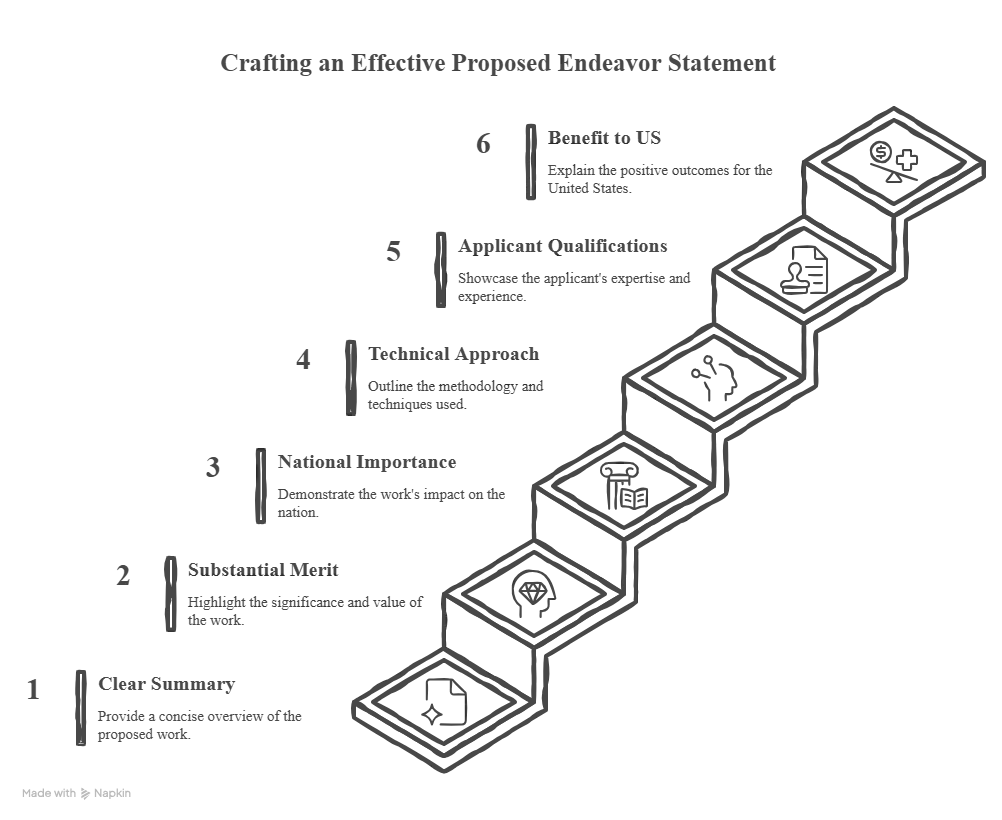
An effective proposed endeavor statement addresses six components in a logical sequence. Each component corresponds to one or more elements USCIS evaluates under the Dhanasar framework.
The statement should open with a direct, concise description of what the applicant intends to contribute. It should be concrete enough to be credible and technical enough to convey expertise, but expressed in terms accessible to an adjudicator without specialist knowledge. A statement such as "I propose to advance machine learning applications in early disease detection by developing diagnostic algorithms that improve accuracy rates for imaging-based cancer identification" is more effective than "I intend to work in AI and healthcare."
The statement must explain why the work has inherent value in a recognized field. This section addresses Dhanasar Prong 1's substantial merit requirement. It covers the technical, economic, public health, or security significance of the work, independent of the applicant's specific contributions. If the work addresses a documented challenge, cites established research, or builds on a field with recognized importance, those connections should be made explicitly.
This is the most scrutinized section of any proposed endeavor statement. The applicant must demonstrate that the work has implications extending beyond a single employer or user base and that it aligns with recognized U.S. national priorities. Authoritative sources that most directly support national importance arguments include:
Each national importance claim should be supported by a specific, citable source. Adjudicators cannot be expected to assume that cybersecurity, AI, or healthcare technology is nationally important. That connection must be made explicitly and evidenced externally.
The statement should describe, at a level of detail appropriate to the field, how the applicant intends to advance the proposed endeavor. This demonstrates that the applicant has concrete plans and the technical capacity to execute them, directly addressing Prong 2's requirement that the applicant be well-positioned. Abstract intentions are far less persuasive than a statement of approach grounded in the applicant's established expertise and track record.
This section connects the applicant's education, publications, patents, employment history, and peer recognition to the proposed endeavor. It answers why this specific applicant is the person to advance this work. The positioning argument is strongest when the applicant's past achievements directly relate to the proposed area of contribution and when independent recognition, such as citations, awards, or expert letters, confirms their standing in the field.
The final component addresses Prong 3: why waiving normal labor certification and sponsorship requirements serves U.S. interests. Common arguments include the specialized and time-sensitive nature of the work, the applicant's unique qualifications that cannot be adequately evaluated through standard labor market testing, and the national benefit of allowing the applicant to contribute flexibly across employers, research institutions, or self-employment rather than being tied to a single sponsoring organization.
Germany-based professionals sometimes assume that the national importance of their field is self-evident to USCIS. It is not. Every national importance argument in the proposed endeavor statement must be supported by a verifiable, authoritative external source. The following approaches consistently produce the strongest national importance framing.
The proposed endeavor should reference specific government publications that establish the national importance of the applicant's technical domain. A cybersecurity engineer should cite CISA's National Cybersecurity Strategy. An AI researcher should reference the National AI Initiative or the National Science and Technology Council's AI roadmap. A renewable energy engineer should cite the Department of Energy's strategic plans. These citations demonstrate that USCIS is not being asked to make an independent judgment about whether the field is important. The federal government has already said it is.
Where relevant, the statement should include data demonstrating the scope of the problem the applicant's work addresses. The economic cost of cybersecurity breaches per year, the number of Americans affected by a particular health condition relevant to the applicant's research, or the U.S. market share gap in a technology sector where the applicant's work contributes all help establish why the contribution matters at a national scale.
For technology and engineering applicants, framing contributions within the context of U.S. competitiveness in strategic sectors can strengthen the national importance argument. Where the federal government has explicitly identified international competition in AI, semiconductors, biotechnology, or clean energy as a national priority, connecting the applicant's work to that competitive context is appropriate and effective.
For additional context on how the national importance prong is evaluated in EB-2 NIW petitions for Germany-based professionals, see the EB-2 NIW visa overview and the EB-2 green card requirements and timeline guide.
The proposed endeavor must be specific enough that USCIS can assess whether it satisfies the Dhanasar prongs, but general enough that it does not become invalid if the applicant's specific employment changes after filing.
The practical rule is to describe technical contributions and national impact rather than employment logistics. A statement naming a specific employer, project, or role creates a dependency that the NIW is designed to avoid. A statement that describes the area of technical work, the type of contribution, and the national interest being served remains valid regardless of where the applicant works or how their career evolves.
Consider the following framing distinction. A statement that reads "I will develop fraud detection algorithms for U.S. financial institutions by joining the data science team at a specific bank" is employer-dependent. A statement that reads "I will advance fraud detection and financial security infrastructure by developing machine learning models that improve the accuracy and speed of anomaly detection in high-volume transaction environments" describes the contribution independently of employment. Both describe the same work, but only the second version is appropriate for a proposed endeavor statement.
Germany-based applicants should also account for the time between filing and I-140 approval. The proposed endeavor should be coherent both at the time of filing from Germany and after any employment changes that may occur during the processing period. For guidance on how prior I-140 approvals interact with subsequent U.S. employment, see the EB-2 NIW requirements overview.
Standard I-140 processing for EB-2 NIW takes up to 20 months as of 2026. [Check the USCIS processing times page for the most current estimates, as USCIS updates these weekly.]
Premium processing reduces I-140 adjudication to 45 business days at a cost of $2,965, effective March 1, 2026. Germany-based applicants proceed through consular processing after I-140 approval. Applicants who are in the United States on a valid visa at the time of I-140 approval may instead file for adjustment of status via Form I-485, which adds 11 to 32.5 months to the process.
All figures are official USCIS filing fees and do not include immigration firm fees. For guidance on filing I-140 and I-485 together when a priority date is current, see the concurrent I-140 and I-485 filing guide.
Beyond Border works exclusively with high-skilled professionals on employment-based immigration pathways. For Germany-based professionals, the firm reviews technical credentials and career trajectory before drafting a proposed endeavor statement that satisfies all three Dhanasar prongs and is supported by documented external evidence.
Petitions are prepared and submitted within one month of receiving all supporting documents. Beyond Border offers a money-back guarantee and same-day responses throughout the process. To begin your proposed endeavor statement and EB-2 NIW petition strategy, book a consultation with the team.
Yes. The entire purpose of the national interest waiver is to waive the job offer and labor certification requirements that apply to standard EB-2 petitions. A Germany-based applicant files the I-140 petition directly with USCIS based on their proposed endeavor and qualifications, without any U.S. employer involvement. After I-140 approval, they proceed through consular processing at the applicable U.S. Embassy in Germany.
There is no USCIS-prescribed length. Most effective proposed endeavor statements for EB-2 NIW petitions run between four and eight pages, covering all six required components with sufficient specificity and supporting citations. A statement that is too brief is unlikely to satisfy the Dhanasar standard. One that is excessively long without adding a substantive argument reduces clarity. The measure is whether every section addresses a specific Dhanasar requirement with a concrete, evidence-based argument.
Yes, within limits. USCIS does not require the applicant to pursue their proposed endeavor with a specific employer or in a specific role. Reasonable evolution in the applicant's technical work is acceptable as long as the nature and national importance of the contributions remain substantially similar to those described in the petition. A cybersecurity engineer who pivots to a different area of the field entirely after approval may face scrutiny. One who advances their cybersecurity work through a different employer or application domain generally does not.
No. However, the document must satisfy legal standards under the Dhanasar framework, which requires familiarity with how USCIS evaluates national importance arguments and how each component of the statement supports a specific prong. Most applicants benefit from professional guidance on structuring the argument, identifying appropriate federal sources, and framing technical contributions in USCIS-accessible language, even if they draft much of the underlying content themselves.
No. EB-2 NIW and EB-1A are evaluated under different legal standards. The proposed endeavor statement is specific to the EB-2 NIW and addresses the Dhanasar three-prong test. EB-1A petitions do not include a proposed endeavor statement. They document extraordinary ability through the ten regulatory criteria. While the underlying facts of the applicant's career support both petitions, each petition requires its own separately structured legal document. For a comparison of when each pathway is appropriate, see the EB-2 NIW vs EB-1A guide for German professionals.