Many Chinese professionals in research, technology, startups, business, finance, biotech, and engineering often face a difficult U.S. immigration process. The H-1B lottery is uncertain, green card backlogs can be long, and many high-achieving applicants need a work visa option that reflects their actual accomplishments. The O-1 visa may be a strong pathway for Chinese professionals who can prove extraordinary ability through recognized achievements, measurable impact, and a clear U.S. work plan.
Chinese professionals can qualify for the O-1 visa by showing strong evidence of achievement, recognition, and impact in their field. The case is not based on nationality, job title, or the reputation of an employer alone. It must show that the applicant stands out professionally and has a valid U.S. petitioner, employer, agent, or qualifying work arrangement.
For many Chinese applicants, the most relevant category is O-1A, which covers fields such as science, business, technology, research, entrepreneurship, engineering, finance, and athletics. A strong case may include evidence such as publications, citations, patents, funding, awards, press, technical contributions, critical roles, or expert recognition.

The O-1 visa could be a good option for Chinese professionals because it is based on extraordinary ability, not random selection. For applicants who already have strong achievements, recognition, and field-level impact, the O-1 can help present their profile to USCIS in a stronger and more evidence-based way.
Many Chinese professionals first consider the H-1B because it is one of the most familiar U.S. work visa options. However, cap-subject H-1B cases usually depend on employer registration and lottery selection before the petition can move forward.
For FY 2026, USCIS reported 343,981 eligible H-1B registrations and confirmed that it received enough petitions to reach the FY 2026 H-1B cap. That means many qualified professionals could not move forward simply because the category has numerical limits.
The O-1 is different because it does not have an annual lottery. A qualified applicant can pursue the O-1 if there is a valid petitioning structure and enough evidence to support the case.
This can be useful for Chinese researchers joining U.S. labs, founders expanding into the U.S., AI professionals joining fast-growth companies, and business leaders taking on specialized U.S. roles.
The O-1 may also work to seek a long-term stay in the US. A Chinese founder, researcher, or engineer may use the O-1 to work in the U.S. while building a longer-term green card strategy through EB-1A or another immigrant pathway.
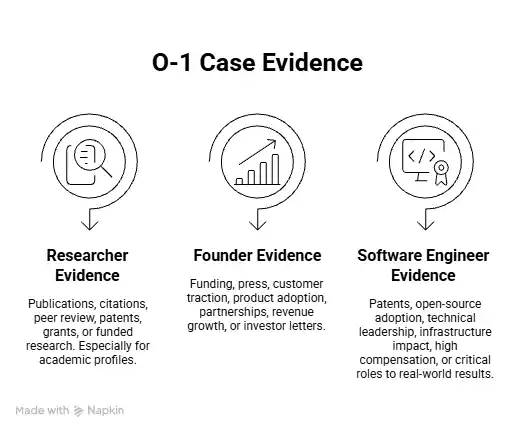
The right evidence depends on the applicant’s field. A researcher may use publications, citations, peer review, patents, grants, or funded research, especially for academic profiles like those covered in our guide on the O-1 visa for PhD students. The O-1 visa for a Chinese founder may rely on funding, press, customer traction, product adoption, partnerships, revenue growth, or investor letters, which are explained in our guides on strong O-1 visa founder profiles and the O-1A visa for startup founders.
The key is to show why the work matters and how the applicant stands out. For software engineers and AI professionals, this may mean connecting patents, open-source adoption, technical leadership, infrastructure impact, high compensation, or critical roles to real-world results. Beyond Border’s guide on the O-1 visa for software engineers and AI researchers explains this in more detail.
For many Chinese professionals, U.S. immigration planning is not just about getting a visa. It is about avoiding career delays. H-1B lottery uncertainty, green card backlogs, job changes, startup plans, and family planning can all affect long-term stability in the U.S.
The O-1 does not replace every other visa, but it can be a strong option for applicants with clear achievements and strong evidence.
The China green card backlog is one reason many professionals opt for the O-1. Even with a strong immigrant petition, a Chinese applicant may still need to wait for their priority date to become current. The O-1 does not remove that backlog, but it may give qualified applicants a practical U.S. work option while they pursue an EB-1A green card, EB-2 NIW, or another long-term immigration strategy.

A strong O-1 visa for Chinese professionals strategy starts with evidence selection. The biggest mistake is treating the O-1 like a resume review. USCIS is not simply looking for a good job history. It is looking for proof that the applicant has achieved recognition in the field.
The first step is to identify the strongest O-1 criteria instead of trying to prove everything. The O-1 visa for Chinese researchers may include publications, citations, judging, original contributions, and expert letters. For founders, it may include funding, traction, press, awards, customer adoption, and leadership. The O-1 Visa for Chinese engineers and AI professionals, it may include technical contributions, patents, open-source adoption, critical roles, and high compensation.
The second step is to separate personal impact from company impact. This is important for applicants from major companies like Tencent, Alibaba, ByteDance, Huawei, Baidu, JD, Xiaomi, Ant Group, or global technology companies. A well-known employer may help provide context, but the case still needs to show what the applicant personally did.
The third step is to connect the evidence to the proposed U.S. role. The O-1 petition should make it clear what the applicant will do in the United States, who will petition for them, and how the work fits their area of expertise.
The fourth step is to use expert letters carefully. Generic praise is weak. Strong letters explain the applicant’s specific contribution, why it was difficult, how it affected the organization or field, and why the applicant stands out compared with peers.
Beyond Border helps Chinese professionals understand whether the O-1 visa fits their background, evidence, and U.S. plans. We help organize achievements such as research, patents, funding, press, product impact, technical contributions, expert letters, and leadership evidence into a clear case strategy.
Schedule your free consultation and profile evaluation.
Yes. Chinese citizens can apply for the O-1 visa if they meet the extraordinary ability standard and have a valid U.S. petitioner, employer, or agent. The O-1 is based on achievement and evidence, not nationality.
It depends on the applicant’s profile. O-1 may be better for high-achieving Chinese professionals who already have strong evidence and do not want to rely only on the H-1B lottery. H-1B may still work well for standard employer-sponsored roles.
Yes. Chinese startup founders may qualify if they can show evidence such as funding, accelerator acceptance, revenue, users, customers, press, awards, product innovation, or expert recognition. The case should prove that the founder’s work stands out in the field.
Yes. Chinese AI researchers may qualify if they have strong evidence, such as publications, citations, peer review, patents, conference work, research impact, major technical contributions, or critical roles in recognized organizations.
No. The O-1 visa does not remove the China green card backlog. However, it may give qualified Chinese professionals a U.S. work option while they pursue EB-1A, EB-2 NIW, or another immigrant visa strategy.
Chinese professionals generally need a valid U.S. petitioner. This may be an employer, agent, or qualifying petitioning structure. The right setup depends on whether the applicant is joining a company, working across multiple projects, consulting, founding a company, or entering a specialized role.
It can be. If the applicant has strong evidence of extraordinary ability, the O-1 may be worth exploring after H-1B non-selection. However, it should not be treated as a backup for everyone. The evidence must support the O-1 standard.
Yes, many professionals use O-1 as part of a broader immigration strategy. O-1 approval does not guarantee EB-1A approval, but the evidence used for O-1 may help build a stronger future EB-1A case if it is developed carefully.


Address: 4 W 4th Ave, San Mateo, CA 94402, United States
Email: info@beyondborderglobal.com