Search her name and one question keeps surfacing alongside the music headlines is ‘Is Nicki Minaj a US citizen?’ She was born in Trinidad and Tobago, moved to Queens as a child and built one of the most recognizable careers in hip-hop from that foundation. Along the way she has spoken publicly about not holding U.S. Citizenship.
Her story is a real example of how immigrant children become citizens and just as importantly how narrowly they can miss it.
Below, we explain verified information about her background and status. Then we use her case to explain the Child Citizenship Act and when a family needs Form N-600 to prove what should already be automatic.
Here is what the public record actually supports, and where the confusion tends to start.
Nicki Minaj, calledOnika Tanya Maraj on December 8, 1982, in the Saint James district of Port of Spain, Trinidad and Tobago.
The answer to the question ‘what ethnicity is Nicki Minaj’ can be traced back to her parents. Her father, Robert Maraj, is of mixed Afro-Trinidadian and Indo-Trinidadian descent, a combination Trinidad calls Dougla. Her mother, Carol Maraj, is Afro-Trinidadian. The mixed heritage is well documented and consistent across her own public statements and independent reporting.
Her mother left Trinidad first, arrived in New York and eventually secured a green card before she brought the rest of the family over. Minaj joined her in Queens around age five, after she had spent her earliest years in Trinidad with her grandmother.
A parent immigrating first, gaining status, and then bringing over a child later is one of the most common patterns in family-based immigration. It perfectly sets up exactly the kind of situation the Child Citizenship Act was written to address.
Some outlets have called her Jamaican, likely because of her Caribbean accent. However, she is not Jamaican. Trinidad and Tobago and Jamaica are separate countries with different cultures.
Her ethnicity gets flattened too, sometimes reduced to just "Black" or inflated into claims of being "Indian" outright. The accurate description is a specific mixed Afro-Trinidadian and Indo-Trinidadian heritage.
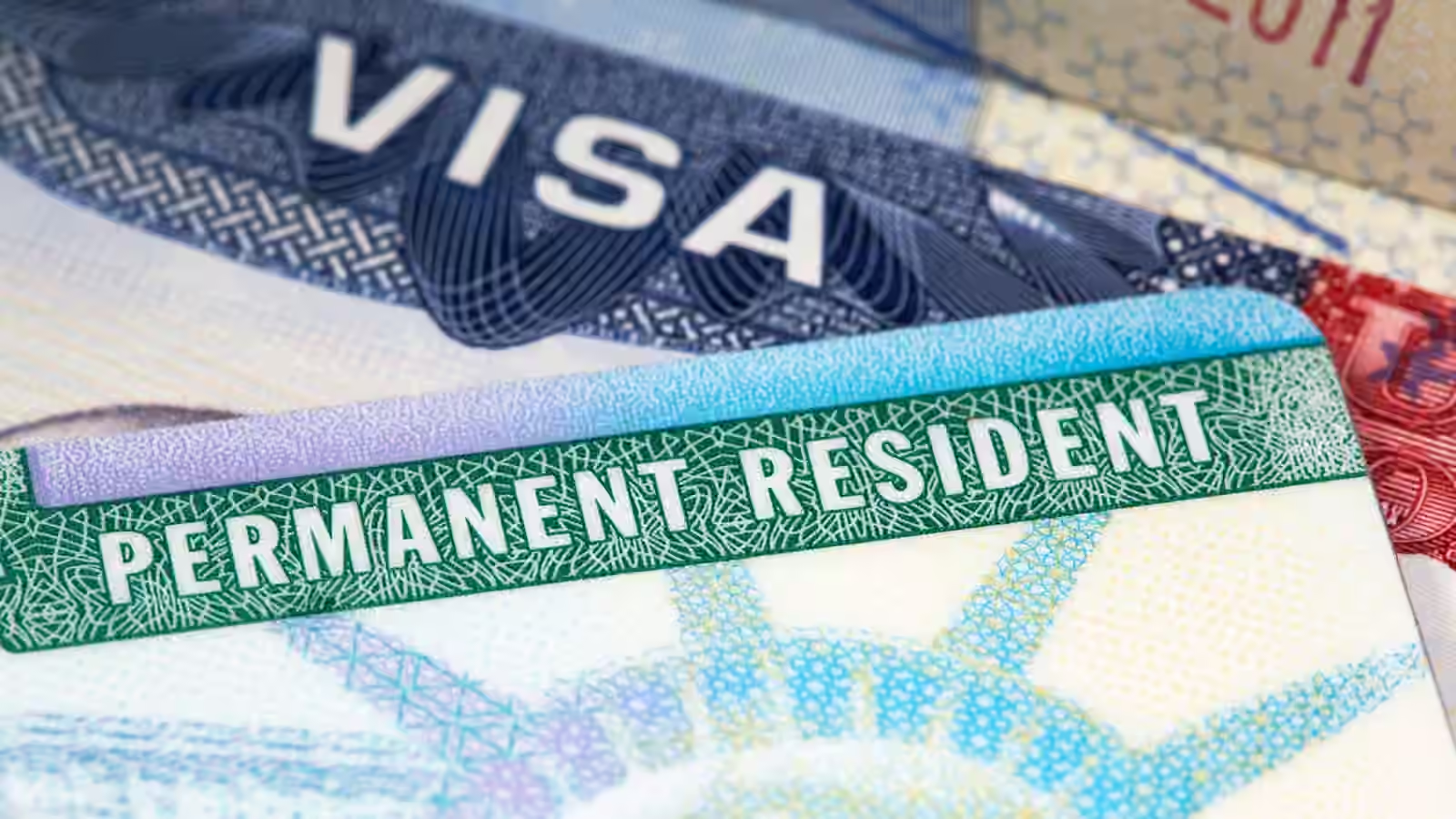
Nicki Minaj’s immigration status right now remains private. However, public reporting identifies her as a lawful permanent resident of the United States, commonly known as a Green Card holder. She has said she is not a U.S. citizen and, as recently as January 2026, said she was finalizing her citizenship paperwork
The distinction is important because holding a Green Card does not make someone a U.S. citizen. While a permanent resident can live and work in the United States indefinitely while retaining citizenship in another country, the status does not come with the full rights of citizenship. This includes voting in federal elections or holding a U.S. passport.
A green card holder and a naturalized citizen are not the same legal status, even though people use the terms loosely. The table below explains the difference.
“Nicki Minaj is not a US citizen”, based on her own words, is the most accurate short answer available as of this writing. What is not publicly confirmed is anything more specific: no documentation of her green card, her naturalization status, or any change to either has been released by her or by any government office.
In January 2026, she appeared alongside President Donald Trump at a Washington event and posted a photograph of a Trump "Gold Card" on social media.
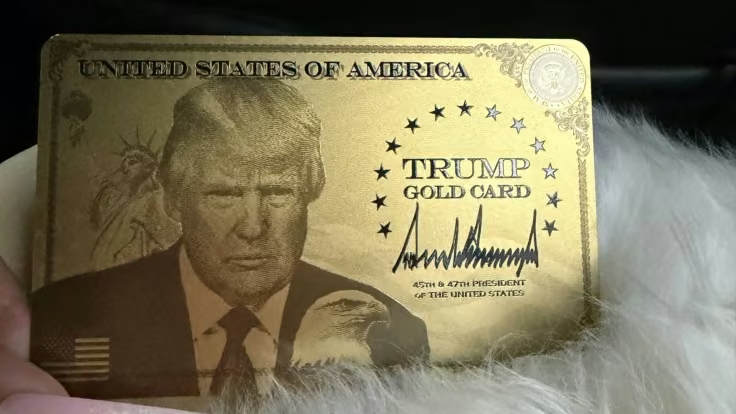
The Gold Card created confusion about what had actually happened to her immigration status. Minaj wrote that she was "finalizing" her citizenship paperwork and said the Gold Card was provided to her "free of charge."
The programme itself was designed to give qualifying foreign nationals a fast-track route to lawful permanent residence, with eventual eligibility for U.S. citizenship. Applicants were expected to pay a $15,000 processing fee and make a $1 million contribution to the U.S. government.
But Minaj's Gold Card should not automatically be treated as proof that she obtained a new immigration status. A White House official later told The New York Times that the gold-coloured card given to Minaj was a memento rather than an actual visa document.
The same report noted that she was already a legal permanent resident and had been pursuing citizenship. This means the card was not necessary to establish her existing residency status.
Minaj's early life follows a pattern immigration attorneys see constantly. A parent goes first, gains status, and brings the children over once that status is secure.
Carol Maraj left Trinidad, established herself in New York, and secured a green card before her children joined her. That sequence, parent first, children later, describes a large share of family-based immigration cases, not just Minaj's. It also creates a specific legal question once the parent's status changes further.
If that parent later becomes a US citizen while the child is still young, does the child automatically become a citizen too, or does the child need to go through the naturalization process independently? The answer depends entirely on timing.
The Child Citizenship Act of 2000, effective February 27, 2001, answers that timing question. Under the law, a child automatically becomes a US citizen the moment three conditions are all met.
If you meet all three, citizenship transfers automatically.
Here is where Minaj's own birthdate becomes instructive:
She was born December 8, 1982, which means she turned 18 on December 8, 2000, almost exactly three months before the Child Citizenship Act took effect. The law only applies to children who were still under 18 on its effective date. Minaj had already aged out before the law existed.
Her case is not an example of derived citizenship working. It is a precise illustration of the cutoff itself, and a reminder that a few months of timing can be the entire difference between automatic citizenship and needing to naturalize independently.
For a child who meets the Child Citizenship Act's three conditions, citizenship happens automatically, but USCIS does not mail a certificate on its own. For someone in Minaj's actual position, having aged out before the law existed, the path runs through naturalization instead.
Filing an N-600 for someone who never automatically qualified, is one of the more common and entirely avoidable mistakes families make.
Minaj's situation is not unusual among high-profile performers and athletes. Extraordinary talent is also a recognized legal pathway into the United States.
The O-1B visa exists specifically for people with extraordinary ability in the arts, or extraordinary achievement in film and television. It requires evidence like major awards, critical acclaim, or a track record of leading roles, and it lets a performer live and work in the US without going through the standard labor certification process most work visas require.
The EB-1A green card is the immigrant version of extraordinary ability recognition. allows a qualifying artist, entertainer, or athlete to self-petition, without needing an employer to sponsor them, based on sustained national or international acclaim.
One well-documented example outside music is professional golfer Nick Price. The Zimbabwe native with 18 PGA Tour wins and a former world number one ranking. He obtained a green card through the EB-1 extraordinary ability category.
Other celebrity immigration claims circulating online do not have that kind of documentation. USCIS records are confidential. So, when an article states that a particular actor or musician "used an O-1 visa," that claim is often assumed except it can be confirmed from a public record.
Minaj's case is really a story about timing and documentation. Neither has to be a problem if handled early.
Without paperwork, that automatic status can be undocumented for years, sometimes decades, until someone needs to prove it in an urgent moment.
File Form N-600 as soon as the conditions are met. Gather the parent's naturalization certificate, the child's green card, and evidence of custody while those documents are easy to locate.
Some adults discover, often later in life, that they actually met the Child Citizenship Act's conditions years earlier and never realized it. If that describes your situation, the fix is the same N-600 application.
Start by confirming the exact date your parents naturalized and cross-checking it against your own age and immigration history at that time. If the timing supports automatic citizenship, an immigration attorney can help assemble the historical records USCIS will want to see.
Remove the celebrity headlines, and Minaj's case is a study in timing, documentation, and the gap between what the law grants automatically and what a family actually has proof of.
The gap is where real problems start, for her and anyone in a similar position.
A performer with genuine international recognition, in music, film, sports, or another creative field, has a well-established path into the US through the O-1B visa. It is the same category built for people whose achievements place them at the top of their field.
Beyond Border's network of specialist attorneys has handled 4,000+ immigration cases, including O-1B petitions for artists and entertainers. We have recorded a 98% approval rate so far.
Do you or someone you represent have extraordinary ability and is exploring a US visa strategy, or your family is untangling a derived citizenship question of your own? Book a free consultation with Beyond Border today.
Not confirmed. She has stated directly, most recently in 2024, that she does not hold US citizenship, and no documentation from her or any government office has confirmed a change since.
She was born in Saint James, Port of Spain, Trinidad and Tobago, and moved to Queens, New York, around age five.
Her mother obtained a green card and later brought the family to the US. Public reporting consistently describes Minaj as holding lawful permanent resident status. No specific documentation of her current card has been published.
Under the Child Citizenship Act, a child under 18 automatically becomes a citizen once a parent naturalizes and the child is living in that parent's legal and physical custody as a lawful permanent resident. No application is required for the citizenship itself to take effect, though families still need to file Form N-600 for official proof.
Not to hold the citizenship itself, since it transfers automatically. You do need Form N-600 and the resulting certificate any time you need to prove that status, such as applying for a US passport or a new job.
No. The US Constitution requires the president to be a natural-born citizen, a requirement naturalization does not satisfy regardless of how long someone has held citizenship.

David Munam is an experienced writer with 10 years of expertise in researching and producing clear, authoritative content on complex and highly technical subjects. His work has focused on turning dense information into accurate, well-structured, and accessible content across areas such as U.S. customs and trade, Web3, fintech, immigration law, and technology. At Beyond Border, he applies this experience to researching and writing in-depth content on U.S. immigration pathways, including O-1, EB-1A, and EB-2 NIW.

Address: 4 W 4th Ave, San Mateo, CA 94402, United States
Email: info@beyondborderglobal.com