72% Drop in H-1B Registrations: Is Global Talent Searching for Other US Visa Pathways?
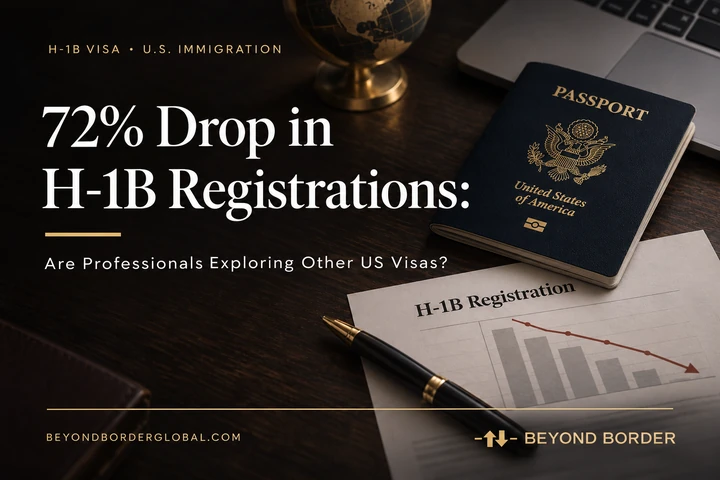
The number of eligible H-1B registrations has plummeted 72% from a high of 758,994 in FY2024 down to 211,600 in FY2027. However, this 72% drop in registrations is not necessarily a 72% drop in the number of people applying for H-1B visas. Much of the initial drop in registrations can be attributed to structural changes in the lottery such as removing the duplicate registrations of single individuals.
According to the September 2026 US High Skilled Immigration Data Report from Beyond Border, the number of eligible registrations was already down to 343,981 in FY2026. This was a 54.7% drop from the baseline in FY2024. The FY2027 numbers were released by USCIS after this report.
In addition, Beyond Border’s internal inquiry statistics show that there is increasing interest in alternative US immigration pathways. These alternatives include the EB-1A extraordinary ability green card, the O-1 non-immigrant visa, and the EB-2 National Interest Waiver (NIW) green card. We are seeing a shift to explore these alternatives, particularly for entrepreneurs and experts based in Asia.
There is uncertainty for both the international talent and prospective employers with several regulatory changes. These changes include the salary based lottery system, proposed $100,000 H-1B filing fee, and changes to prevailing wages.
Three consecutive cycles of declining H-1B registration numbers
USCIS reported a year-over-year decline in eligible H-1B lottery entries from FY2024 to FY2027.
The cumulative drop in eligible registrations from FY2024 to FY2026 was 54.7%. The cumulative drop in eligible registrations from FY2024 to FY2027 was 72.1%.
The initial large drop in registrations is due to the new beneficiary-focused selection process in FY2025. In the new process, each individual gets exactly one entry into the selection pool, regardless of the number of companies submitting a registration for them.
The number of instances where a single beneficiary had multiple registrations plummeted from 408,891 in FY2024 to just 7,828 in FY2026. That’s a staggering 98.1% decrease. These duplicate entries accounted for about 97% of the total drop in registration volume from FY2024 to FY2026.
There was also a decline in the number of unique individuals participating, but it was less dramatic. This number dropped from around 446,000 in FY2024 to 339,000 in FY2026. This is a decline of about 24%. So, the decline in numbers is due both to the change in USCIS counting methodology and a true decline in the number of people entering the lottery (albeit a smaller decline).
The first wage-prioritized H-1B lottery in FY2027
USCIS introduced a selection process that prioritized higher salaries in the 2027 fiscal year. This regulation, which took effect on February 27, 2026, gave candidates with higher salaries a statistical advantage in the lottery pool.
For example:
- Wage Level I positions receive one entry.
- Wage Level II positions receive two entries.
- Wage Level III positions receive three entries.
- Wage Level IV positions receive four entries.
USCIS announced on July 17, 2026 that the H-1B annual limit had been reached. Therefore, there was no need for a second selection round. Of those selected, 71.5% had advanced degrees from US institutions.
This is up from 57% the year before. On the other hand, only 17.7% of the selected pool were registrations for the lowest-tier wage level. It’s hard to isolate the specific reasons for the 38.5% drop in registrations in FY2027. This is because this new selection process coincided with other significant immigration policy changes.
Anxiety about the $100,000 H-1B surcharge among employers
The $100,000 fee for H-1B sponsorship has become a major source of anxiety for companies hiring overseas talent. This fee was established by a presidential proclamation signed on September 19, 2025. It took effect two days later. It required a $100,000 payment for certain H-1B petitions where the beneficiary was outside the US.
The registration period for the visa was in place for FY2027. This fee cannot be blamed for the decline in FY2026. The lottery for that year was completed in March 2025. The legal status of this surcharge has been uncertain. A federal court in Massachusetts struck down the implementing policies on June 8, 2026. On July 24, 2026, the First Circuit Court of Appeals declined to reinstate the fee. However, the original proclamation was extended by the administration until September 21, 2027.
At the beginning of November 2026 the fee was no longer a mandatory requirement for employers to apply for visas for foreign nationals. However, the government is still appealing the adverse judicial decisions. In addition, the Department of Homeland Security (DHS) had a proposal for a $103,265 fee for visa applications. The public review period for this proposal concluded on September 24, 2026. Thus, the costs for visa applications are constantly changing and there are currently many legal disputes surrounding the issue of fees for visa applications for foreign nationals.
Increasing interest in O-1 and EB-2 NIW pathways in Asia.
Beyond Border analyzed ,140 inquiries about US immigration to better understand the preferences of professionals in Asia. The data showed that the O-1 visa was the most popular category. The second most popular category was the EB-2 NIW.
The O-1 visa is for individuals with extraordinary talent in business, science, education, arts, or athletics. This category accounted for 44.7% of total interest. The second most popular pathway was the EB-2 NIW. This category had 247 inquiries. This green card allows professionals to avoid employer sponsorship if they can demonstrate that their work significantly benefits the national interest of the US. There were also 241 individuals who were still undecided on the specific category that fit their professional credentials. These statistics represent the interests of Beyond Border’s potential clients. They should be seen as an indicator of growing curiosities. This is not a comprehensive picture of the entire US immigration market or official approval rates.
EB-1A approvals are increasing, but EB-2 NIW approvals are decreasing
There are contrasting trends for approvals of different employment-based visa categories. This is based on official government records. From FY2023 to FY2025, there was a 20.4% increase in successful EB-1A applications. This number increased from 10,356 to 12,468 approvals. Conversely, there was a 38.7% decrease in EB-2 NIW approvals during the same period. This number declined from 31,889 to 19,532.
The number of O-1 and O-2 visas approved for individuals of extraordinary ability in business, science, education, arts, or athletics remained relatively flat for the same period. However, approvals for the L-1 visa for intracompany transferees decreased by 30.7% for the same period. In addition, USCIS processed 278,650 H-1B petitions in the first nine months of FY2026. Of those, USCIS approved 270,419 and rejected 8,231. This is a success rate of 97%. Of those approved, 86,346 were for new employment. 184,073 were for ongoing roles. Note that the total number of H-1B approvals includes transfers and renewals. This means that the total number is broader than just new lottery winners.
EB-2 backlogs begin with the October 2026 Visa Bulletin
The October 2026 Visa Bulletin has changed the EB-2 category (including NIW) from “Current” to a final action date of January 1, 2025 for most nationalities. Those with priority dates before March 15, 2026 will still be able to submit their filings, but they will have to wait until their specific dates are current before they receive a final decision on their cases.
The EB-1 category remained “Current” for most countries. There was very little change in the November 2026 Bulletin. This new waiting period could significantly change the timeline for professionals who plan to use the EB-2 NIW pathway to permanent residency.
Domestic professionals are also exploring other pathways to permanent residency
Beyond Border analyzed a dataset of 6,428 inquiries from professionals residing in the US to better understand their behavior in exploring other permanent residency pathways. The timeframe and geography of this data are not defined. However, the data is telling. Of the 1,724 O-1 inquiries by non-founders, 927 of those individuals (53.8%) are already in the US.
There are also 858 inquiries from researchers, developers, and other skilled professionals. There are 1,153 non-founding professionals in the US on various visas who are exploring options for EB-1A or EB-2 NIW green cards. This shows that the interest in alternative visa types is not limited to those abroad who want to move. It is also a phenomenon among those who are already integrated into the US workforce.
Founders have a lot of challenges navigating US immigration
The Founder Mobility Pulse survey was conducted by Beyond Border in August 2026. This survey collected insights from 307 entrepreneurs globally. This included over 200 entrepreneurs in Asia. Of the Asian entrepreneurs:
- 55% said the main challenge with immigration was deciding on the right visa.
- 88.9% said the main barrier to expansion to the US was uncertainty related to visas and immigration.
- 89.9% said they only started exploring options for US visas when they were ready to actually move.
While the data collected is from a small, self-selected sample of founders, it provides insight into the main challenges that business owners face in the process of expanding their business to the US.
Conclusion
The drop in H-1B numbers for the registration period of FY2027 was 72% down from the previous year. While some of the decline in numbers can be attributed to structural changes to the lottery, there was also a genuine drop in the number of unique individuals that applied for H-1B visas. The environment for international talent and US employers is more complex than ever with the shift to a wage-weighted selection process for the lottery and the ongoing regulatory uncertainty surrounding the immigration system.
Beyond Border proprietary data shows that growing numbers of founders and experts based in Asia are interested in the EB-1A, O-1 and EB-2 NIW categories. This is also the case for individuals already established in the US. However, each visa category has its own set of requirements for evidence and there are different challenges to gain approval for each category. It is therefore crucial that professionals carefully consider their circumstances and future plans before making a switch from the H-1B visa.
Frequently Asked Questions
The decline from 758,994 in FY2024 to 211,600 in FY2027 can be attributed to several factors including changes to the lottery system, such as removing duplicate registrations, but also because the number of unique applicants has declined.
The new wage-based H-1B lottery system, introduced for FY2027, is based on a candidate’s salary level. Candidates with Wage Level I positions receive one entry into the lottery, whereas those with Level IV positions receive four entries into the lottery, increasing the chances of selection for higher paid candidates.
Some alternatives to the H-1B visa that are currently gaining attention from international professionals and entrepreneurs are the O-1, EB-1A and EB-2 NIW categories. According to the proprietary data of Beyond Border, the O-1 category makes up 44.7% of all inquiries, whereas the EB-2 NIW category accounts for 21.7% of inquiries.
Approval trends for EB-1A and EB-2 NIW visas differ. While EB-1A approvals increased by 20.4% from 10,356 in FY2023 to 12,468 in FY2025, EB-2 NIW approvals declined by 38.7% from 31,889 in FY2023 to 19,532 in FY2025.
The EB-2 NIW category remains an option for foreign professionals seeking to obtain a green card in the US. However, as noted above, the October 2026 Visa Bulletin announced a final action date of January 1, 2025 for most nationalities, potentially increasing waiting times for applicants.