EB-1B Processing Time: Current Timeline in August 2026

The total EB-1B processing time is 38 months and is a combination of four stages. See what each stage entails, when you can speed it up and how to check your timeline.
Last Updated
August 12, 2026
Written by
Reviewed By
Team Beyond Border
US Passport
Table of Content
- Toc Heading
- Toc Heading
- Toc Heading
- Toc Heading
- Toc Heading
- Toc Heading
- Toc Heading
- Toc Heading
!
Key Takeaways About EB-1B I-140 Processing:
  • »
    As of August 2026, USCIS reports that it has completed 80% of EB-1B (E12) I-140 petitions in about 15.5 months, which is currently the fastest of the three EB-1 categories.
  • »
    Premium processing costs US$2,965 and commits USCIS to act within 15 business days, but only your employer can file the request.
  • »
    The EB-1B has no self-petition option, so the case preparation stage in your petition process depends on your employer/institution.
  • »
    Researchers chargeable to India face an EB-1 final action date of October 15, 2022, and the State Department has warned the category may become unavailable before the fiscal year ends.
  • »
    An approved I-140 is valid indefinitely, and its priority date can transfer to a later EB-1 or EB-2 petition.

The EB-1B timeline comprises four stages: case preparation, I-140 processing, priority date wait, and I-485 processing. They are all controlled by different parties: your institution, USCIS, then the State Department, then USCIS again. Beyond Border attorneys have collectively handled 4,000+ immigration cases across O-1, EB-1, and NIW categories. The guidance below sets out what each stage currently takes and what you can influence. 

What is the Total EB-1B Processing Time in 2026? 

The total EB-1B processing time is roughly 38 months from case preparation to adjustment of status. Here’s a breakdown of all the activities involved and the timeline. 

Stage Who Controls It Duration, as of August 2026 Can You Speed It Up?
Case preparation Your employer 2 to 3 months
Varies widely
Yes, by assembling evidence and resolving the offer letter early
I-140 petition (E12) USCIS About 15.5 months with standard processing, or 15 business days with premium processing Yes, but only your employer can request premium processing
Priority date wait U.S. Department of State None for most countries; years for India and China No
I-485 or consular processing USCIS or the National Visa Center About 8.5 to 38 months for employment-based adjustment No

Case preparation

Who controls it

Your employer

Duration, as of August 2026

2 to 3 months, although timing varies widely

Can you speed it up?

Yes, by assembling evidence and resolving the offer letter early

I-140 petition (E12)

Who controls it

USCIS

Duration, as of August 2026

About 15.5 months with standard processing, or 15 business days with premium processing

Can you speed it up?

Yes, but only your employer can request premium processing

Priority date wait

Who controls it

U.S. Department of State

Duration, as of August 2026

None for most countries; years for India and China

Can you speed it up?

No

I-485 or consular processing

Who controls it

USCIS or the National Visa Center

Duration, as of August 2026

About 8.5 to 38 months for employment-based adjustment

Can you speed it up?

No

Here is what happens in each stage, in order.

1. Case preparation: Your department decides to sponsor you, engages counsel, and assembles the petition. The work in this stage is to establish three things: that you have at least three years of qualifying teaching or research experience; that your position is tenured, tenure-track, or permanent as USCIS defines that term; and that at least two of the six regulatory criteria for international recognition are met. This stage can take 2 - 3 months to prepare. 

2. I-140 adjudication: Your employer files Form I-140 under classification E12, and the date USCIS properly receives it becomes your priority date. As of August 2026, USCIS reports that it completes 80% of E12 petitions in about 15.5 months with standard processing, or in 15 business days with premium processing.

3. Priority date wait: An approved I-140 does not by itself entitle you to a green card. A visa number must be available for your category and country of chargeability, as published monthly in the visa bulletin.

For most nationalities, the EB-1 category is current, so this stage takes no time at all and you move straight to the next one. For researchers chargeable to India and mainland China, it is currently the longest stage by a wide margin, and no fee, petition strategy, or expedite request shortens it.

4. Adjustment of status or consular processing: Once a visa number is available, you either file Form I-485 to adjust status inside the United States or complete consular processing at a U.S. embassy abroad. Employment-based adjustment is currently 8.5 to 38 months, and neither route offers premium processing.

EB-1B I-140 Processing Time

The EB-1B is filed on Form I-140 under classification E12, for outstanding professors and researchers and is the first stage in the EB-1 Green Card process. As of August 2026, the EB-1B I-140 processing time is approximately 15.5 months with standard processing.

EB-1 Category Classification I-140 Processing Time, August 2026
Extraordinary ability (EB-1A) E11 About 30 months
Outstanding professor or researcher (EB-1B) E12 About 15.5 months
Multinational executive or manager (EB-1C) E13 About 26.5 months

Extraordinary ability (EB-1A)

Classification

E11

I-140 processing time, August 2026

About 30 months

Outstanding professor or researcher (EB-1B)

Classification

E12

I-140 processing time, August 2026

About 15.5 months

Multinational executive or manager (EB-1C)

Classification

E13

I-140 processing time, August 2026

About 26.5 months

Those in the U.S. with another valid status can file Form I-485, which takes 8.5 to 38 months to process. If you’re abroad, you will undergo consular processing at a U.S. consulate abroad. 

Alternatively, you can file Form I-140 and Form I-485 at the same time, known as concurrent filing, only if an immigrant visa number is immediately available for your preference category and priority date. 

Is Premium Processing Worth It for the EB-1B?

Premium processing is worth it if you’re on a deadline and need to make a decision. It reduces your processing time to 15 business days, down from 15 months. The only consideration is the cost, as it is now USD$2,965. 

Before deciding whether to use premium processing or not, consider these; 

  • It buys an action, not an approval. USCIS commits to issuing an approval notice, a denial notice, a notice of intent to deny, or a request for evidence within the period, or to refunding the fee and continuing expedited processing. A request for evidence therefore satisfies that commitment. More importantly, when USCIS issues a Request for Evidence or a notice of intent to deny, the premium processing clock stops. A new period begins only when USCIS receives your complete response. A request for evidence does not merely add time to a premium case. It restarts the commitment you paid for.
  • It covers one stage only. Premium processing applies to the I-140. It does not apply to adjustment of status or to consular processing. Additionally, only the petitioner, or an attorney who has filed Form G-28 on the petitioner's behalf, may request premium processing. You may pay the fee, but you cannot sign or file the Form I-907. 

Need help with your U.S. visa application?

Book a free call with our expert immigration team

Request A Consultation

How to Check Your EB-1B Processing Time

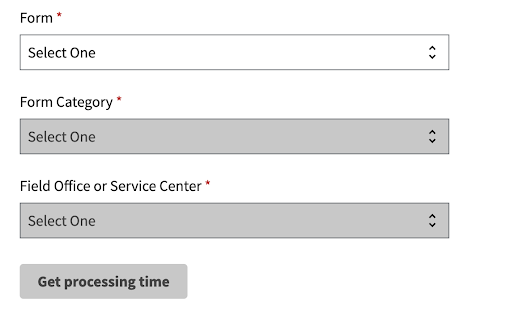
You can estimate how long your EB-1B processing time will take via the official USCIS processing times tool. Follow these steps to check it; 

  • Visit the USCIS processing times tool 
  • Select Form I-140, Immigration Petition for Alien Workers 
  • Under Form Category, select “Outstanding professor or researcher (E12)”
  • Under Field Office or Service Center, Select Service Center Operations. This is because USCIS now publishes I-140 processing times under a single office called Service Center Operations (SCOPS).
  • Then click the “Get processing time” button. 

You can also send a case inquiry, like a follow-up. Petitioners can submit a case inquiry once an EB-1B case has been pending for more than 19.5 months.
eb1b processing time - beyond border

What Can Extend an EB-1B Timeline?

  • A request for evidence regarding international recognition: USCIS conducts a two-step review of EB-1B petitions. The first step evaluates whether you meet at least two of the six criteria. The second step evaluates the total record as a whole to determine whether you have national or international acclaim. If you satisfy step one but fail step two, USCIS may issue an RFE, which extends your processing time. 
  • An offer letter that does not establish permanence. Your offer letter must describe continued employment. If it does not, it may lead to a request for evidence even where the underlying position qualifies.
  • An undocumented three-researcher test. Where the petitioner is a private employer, the department must demonstrate that it employs at least 3 full-time research employees and has documented accomplishments in the field. Departments filing their first EB-1B petition often treat it as self-evident and do not provide supporting evidence.
  • Retrogression. This one is different. A priority date that is not current is not a processing delay, cannot be inquired about, and is not affected by the quality of your petition. Separate your own planning from the delays that petition preparation can prevent.

EB-1B, EB-1A, or EB-2 NIW: Choosing on Timeline as Well as Eligibility

While most researchers considering EB-1B qualify for other categories, you must weigh the processing timelines against your specific needs.

EB-1B is currently USCIS's fastest path, averaging 15.5 months compared to EB-1A's 30 months as of August 2026. However, employer speed matters. If your department takes eight months to authorize a filing, the EB-1B’s speed advantage disappears. In contrast, you control the EB-1A schedule because it is a self-petition.

For researchers chargeable to India, these differences are secondary to a final action date currently in October 2022. Here, the priority is securing and retaining an early priority date, making parallel or subsequent filings a more effective strategy than waiting for a single category.

Sometimes, waiting is the best option. You cannot apply for the EB-1B if you lack three years of post-degree experience or hold a fixed-term fellowship rather than a permanent role, no matter how strong your record.

Similarly, it may not be an option for those at government agencies that aren't higher-learning institutions. In these cases, the focus should shift to the category that best fits your current reality.

Get a clear answer before committing. Request an EB-1 case assessment for an honest evaluation of your eligibility, timeline, and chargeability.

We have handled this before, We'll help you handle it now

Speak with Beyond Border's expert attorney and get clarity on your next steps.
Request A Consultation

Frequently Asked Questions

How long does the EB-1B green card take from start to finish?

As of August 2026, the total processing timeline for the EB-1B is 38 months. This includes all the stages until you receive your green card. EB-1B I-140 processing time is 15.5 months or 15 business days with premium processing,

Is the EB-1B faster than the EB-1A, and why is the gap so wide right now?

At the petition stage, yes. As of August 2026, the EB-1B processing time is 15.5 months, compared with approximately 30 months for the EB-1A. USCIS does not publish the reasons for the divergence, so you cannot identify the reason. Nonetheless, the EB-1B advantage also depends entirely on having an employer willing to petition, since the category has no self-petition option.

Can I pay for premium processing on my own EB-1B petition?

You can pay the fee, but you cannot file the request. USCIS permits only the petitioner, or an attorney who has filed Form G-28 for the petitioner, to sign and file Form I-907. The exception for self-petitioners does not apply to EB-1B because the category requires an employer to file the petition. Your institution has to agree to make the request.

How long will an Indian national wait for an EB-1B green card?

The August 2026 Visa Bulletin lists the EB-1 final action date for India as October 15, 2022, so a petition filed now is roughly three years and ten months behind. USCIS has also warned that EB-1 may be unavailable to Indian nationals for the remainder of fiscal year 2026.

Can I file the I-485 at the same time as the I-140 for the EB-1B?

Yes, but only if a visa number is available to you, which depends on your chargeability and the current bulletin. For most chargeability areas, the EB-1 category is current; for India and mainland China, it is not.

Does an approved EB-1B I-140 expire if my priority date is years away?

No. An approved employment-based petition is valid indefinitely unless USCIS revokes it. The priority date it establishes also carries to later petitions filed under other employment-based categories, which is why it’s important to file early.

Author's Profile
Legal Head Beyond Border - Camila Facanha
Camila Façanha
Head of Legal & Legal Writer
Camila is the Head of Legal at Beyond Border, where she specializes in O-1, EB-1A and EB2-NIW visas. Camila is an OAB-certified lawyer, with 8 years of relevant US immigration experience. Camila has personally secured approval more than 100 O-1, EB-1A and EB2-NIW cases and maintained a perfect approval track record so far. Camila holds a Master's degree in Law from the Universidade Catolica Portuguesa, and is a sought after voice in the U.S. extraordinary alien visa field in press including Times of India.