
The EB-1B visa is a green card category for outstanding professors and researchers who have strong academic or research achievements and a qualifying U.S. employer sponsor. It is often used by university faculty, research scientists, postdoctoral researchers moving into permanent roles, and private-sector researchers with recognized work in their field.
Unlike many employment-based green card options, EB-1B does not require PERM labor certification. That can make it a more direct path for qualified academics and researchers. But it is not automatic. USCIS expects clear evidence of international recognition, at least three years of teaching or research experience, and a proper job offer from a qualifying employer. USCIS identifies outstanding professors and researchers as part of the EB-1 first preference category.
The EB-1B visa is an employment-based immigrant category for professors and researchers who are internationally recognized as outstanding in a specific academic field. It is part of the EB-1 green card category and is designed for people whose work has already gained meaningful recognition beyond a single employer or institution.
The EB-1B category is mainly for professors, university researchers, academic scientists, postdoctoral researchers entering permanent research roles, and private-sector researchers working in established research divisions.
A strong candidate may have peer-reviewed publications, citations, research leadership, conference recognition, invited reviews, funded projects, or work adopted by other scholars, institutions, or industry groups.
The biggest advantage is that EB-1B does not require PERM labor certification. That means the employer does not need to test the U.S. labor market in the same way required for many EB-2 and EB-3 employer-sponsored cases.
However, the EB-1B requirements are still demanding. The applicant must show more than a degree, job title, or internal employer praise.
The EB-1B visa has three core requirements: international recognition, at least three years of teaching or research experience, and a qualifying U.S. job offer. USCIS policy also discusses the need for a permanent research position where applicable.
International recognition means the applicant has been recognized as outstanding in their field of study. This does not always require global fame, but the evidence should show that experts outside the applicant’s immediate workplace know and value their work.
Examples may include citations, peer-review invitations, conference roles, selective awards, independent recommendation letters, or research others have used.
Applicants generally need at least three years of teaching or research experience in the academic field. Experience gained during advanced degree work may help if it is properly documented and recognized as significant.
EB-1B is not a self-petition category. The applicant needs a U.S. employer sponsor. The role should generally be tenured, tenure-track, or a comparable permanent research position.
PhD holders comparing EB-1 options can also read Beyond Borders’ guide on EB-1 green card for PhD holders, which explains eligibility, common myths, and how research achievements may support a stronger petition.
Strong EB-1B evidence should connect achievements to international recognition. The petition should not just list publications or awards. It should explain why those achievements matter.
Strong evidence usually comes from outside the applicant’s direct employer. Independent citations, respected journals, competitive grants, selective peer review, and expert letters from unaffiliated leaders often carry more weight.
Weak evidence includes generic recommendation letters, low-selectivity memberships, internal praise, student-level awards, or publications with no proof of influence.
Researchers in STEM fields may also want to compare EB-1B with Beyond Borders’ EB-2 NIW for STEM talent, especially if their work supports U.S. national priorities.
Expert letters should explain the applicant’s work in plain terms. The best letters do not simply say the applicant is excellent. They explain what the applicant contributed, who benefited, and why the work is important in the field.

EB-1B employer sponsorship is one of the biggest differences between this route and self-petition options. The U.S. employer files Form I-140 for the applicant.
After the employer files Form I-140, processing time becomes an important planning factor, especially for Indian applicants and professionals already in the U.S. on H-1B or L-1 status. For a deeper timing breakdown, read Beyond Borders’ guide on EB-1 green card premium processing time.
A sponsor may be a U.S. university, institution of higher education, or qualifying private employer. Private employers generally need to show that they have an established research function and documented accomplishments.
No. EB-1B requires an employer sponsor. If you do not have a qualifying sponsor, Beyond Borders’ EB-2 NIW green card route may be more suitable because EB-2 NIW can allow self-petitioning when the proposed work has national importance.
Many professors and researchers compare EB-1B with EB-1A and EB-2 NIW because all three may fit high-achieving academic profiles. The right choice depends on your employer situation, evidence, and long-term plan.
For current adjudication timing, see our EB-1B processing time guide, including standard and premium-processing considerations.
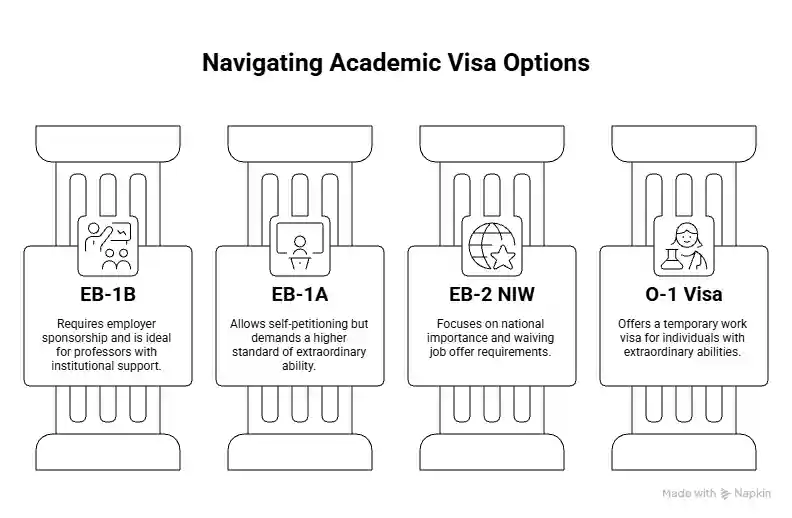
EB-1B requires employer sponsorship. EB-1A allows self-petitioning but usually requires a higher extraordinary ability standard. EB-1B may be better for a professor or researcher with a strong institutional sponsor and a permanent academic or research position.
Read more our guide on EB-1A here.
EB-2 NIW focuses on whether the applicant’s proposed work has national importance and whether waiving the job offer and labor certification is justified. EB-1B focuses more directly on outstanding academic recognition.
For education-focused applicants, Beyond Borders’ guide on EB-2 NIW for educators and academics can help compare how faculty work may fit a national interest strategy.
The O-1 visa for individuals with extraordinary ability is temporary, not a green card. Still, it can be useful for researchers who need a faster work visa option before or alongside an EB-1B, EB-1A, or EB-2 NIW plan.
The EB-1B visa may be a strong fit if you have a qualifying U.S. employer sponsor, at least three years of teaching or research experience, and evidence that your academic work is recognized beyond your workplace.
It may not be the best fit if you do not have a sponsor, your role is temporary, or your evidence is stronger for national interest than international academic recognition. In those cases, EB-1A, EB-2 NIW, or O-1 may be worth comparing.
Beyond Border helps professors, researchers, and high-skilled professionals assess the right immigration strategy across EB-1B, EB-1A, EB-2 NIW, and O-1.
Schedule your free consultation and profile evaluation.
Yes. The EB-1B visa is an immigrant category that can lead to a U.S. green card for outstanding professors and researchers.
Yes. EB-1B requires a qualifying U.S. employer sponsor. It is different from EB-1A and EB-2 NIW, which may allow self-petitioning.
A PhD is common, but it is not the only issue. USCIS looks at international recognition, teaching or research experience, the job offer, and supporting evidence.
For some academics, yes. EB-1B may be more practical when there is a strong employer sponsor. EB-1A is more flexible because it allows self-petitioning, but the evidentiary standard can be harder.
Yes. Private company researchers may qualify if the employer has a proper research function, documented accomplishments, and a qualifying permanent research position.

Address: 4 W 4th Ave, San Mateo, CA 94402, United States
Email: info@beyondborderglobal.com