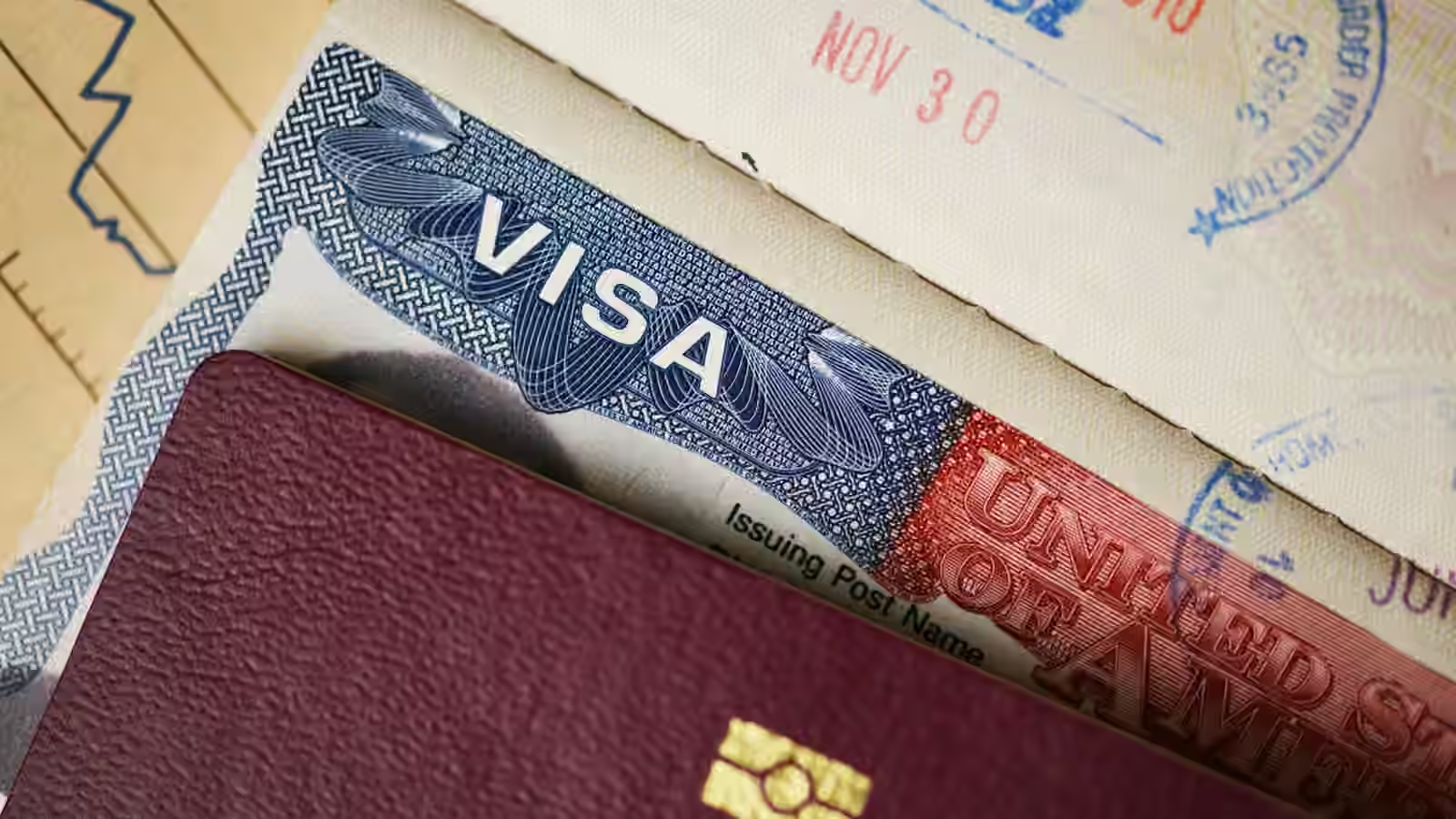
Understand EB-1 premium processing in 2026, including EB-1A, EB-1B, and EB-1C timelines, USCIS fees, and key points for Indian applicants.

Beyond Border supports EB-1A, EB-1B, and EB-1C green card petitions in 2026 with a 98% approval rate and a structured intake process that assesses I-140 eligibility, premium processing strategy, and concurrent adjustment of status options from the outset.
The EB-1 green card is widely regarded as the fastest route to U.S. permanent residence for individuals with extraordinary ability, outstanding research credentials, or multinational executive roles. But how long the process actually takes in 2026 depends significantly on which EB-1 sub-category applies, whether premium processing is used, and the applicant's country of birth. This guide covers realistic timelines by visa type and nationality, explains what premium processing does and does not accelerate, and outlines the fastest available routes.
The EB-1 green card process has two main stages. The first is Form I-140, the immigrant petition filed with USCIS, which establishes the applicant's eligibility and sets their priority date. The second is adjustment of status (Form I-485 for applicants inside the U.S.) or consular processing for applicants abroad.
For the I-140 stage, premium processing via Form I-907 costs $2,965 effective March 1, 2026, and guarantees USCIS action within 15 business days. Without premium processing, standard I-140 processing currently runs approximately 4 to 8 months, depending on the service centre and case volume. For adjustment of status or consular processing, timelines run 8 to 14 months, depending on the Visa Bulletin movement and USCIS workload at the applicant's service centre.
For EB-1A and EB-1B applicants from countries without visa backlogs who can file I-140 and I-485 concurrently, the total process from petition preparation to green card approval typically runs 12 to 18 months. For Indian nationals under EB-1C, delays in visa number availability significantly extend the timeline.
Premium processing is available for EB-1A, EB-1B, and, where the employer requests it, EB-1C petitions. It guarantees a 15-business-day USCIS response on the I-140 petition. The critical distinction is that premium processing accelerates only the I-140 stage. It does not compress the adjustment-of-status timeline, change priority-date movement in the Visa Bulletin, or affect consular-processing scheduling.
Where premium processing adds real value: for applicants planning a job change, where I-140 approval establishes portability rights; for applicants who want certainty about their petition outcome before making relocation or dependent authorisation decisions; and for applicants whose priority date is already current, where faster I-140 approval enables earlier concurrent I-485 filing and earlier access to EAD work authorisation.
Where premium processing has limited impact: for Indian nationals whose EB-1C priority date is not current, a 15-business-day I-140 decision does not change the overall timeline; the bottleneck is priority date movement, not I-140 adjudication speed.
EB-1C green card processing for Indian nationals in 2026 is slower than for applicants from non-backlogged countries. USCIS typically takes 8 to 12 months or longer to adjudicate an EB-1C I-140 petition under standard processing. After I-140 approval, Indian applicants often wait an additional 6 to 18 or more months for priority dates to become current under the monthly Visa Bulletin before they can file I-485.
For Indian nationals, total EB-1C timelines of 24 to 36 months or more from I-140 filing to green card approval are common in 2026. The most effective strategy for Indian EB-1C applicants is to file the I-140 as early as possible to lock in the earliest priority date, and to monitor the Visa Bulletin monthly so that the I-485 can be filed immediately when the priority date becomes current.
For H-1B visa holders who qualify, the EB-1 pathway is materially faster than EB-2 or EB-3, and the difference is particularly stark for Indian nationals.
EB-1A and EB-1B do not require PERM labour certification. This eliminates one of the longest and most unpredictable steps in the employment-based green card process. For Indian H-1B holders qualifying for EB-1A, the total timeline is often 12 to 18 months if the priority date is current, compared to 7 to 15 or more years for Indian nationals pursuing EB-2 or EB-3 through PERM. A researcher with an internationally recognised publication record and peer-review experience, for example, may qualify for EB-1A and avoid the entire PERM process, which would otherwise define their green card timeline.
For H-1B holders evaluating whether EB-1A or EB-1B applies to their profile, a specialist attorney should assess the evidence at intake against USCIS's specific evidentiary criteria before any petition preparation begins.
Explore Beyond Border's EB-1 visa page for full guidance on the extraordinary ability and outstanding researcher standards.

L-1B visa holders, employees with specialised knowledge, are not typically eligible for EB-1C directly. EB-1C requires managerial or executive duties, which is the standard that qualifies L-1A holders but not L-1B holders, whose roles are defined by specialised technical knowledge rather than management function.
In most cases, an L-1B employee must transition to an L-1A managerial or executive role before filing for EB-1C. That role transition itself may take six or more months to formalise, both in the employer's internal restructuring and in the documentation of the new qualifying role to USCIS standards. This adds to the overall timeline before the EB-1C I-140 can even be filed.
For L-1B holders from India, this sequence, role transition to L-1A, then EB-1C I-140, then priority date wait, means total timelines that extend well beyond the 12 to 18 month range available to non-backlogged EB-1A applicants. Strategic planning around the timing of the L-1A transition is the most important early action for Indian L-1B holders with long-term U.S. residence goals.
See Beyond Border's L-1 visa for specialists page for guidance on the L-1B to L-1A transition process.
Several practical actions materially reduce EB-1 processing time in 2026. Filing the I-140 with premium processing eliminates the multi-month standard I-140 wait and enables earlier concurrent I-485 filing. Preparing comprehensive evidence before filing, awards, recommendation letters, publications, citation benchmarks, salary data, and expert letters significantly reduces RFE risk, which is the most common cause of four-to-six-month delays in the I-140 stage.
Tracking the USCIS Visa Bulletin monthly is essential for applicants from countries with backlogs. Filing I-485 immediately when the priority date becomes current, rather than waiting and missing the current month, prevents unnecessary additional delays. For applicants abroad, consular processing may be faster than adjustment of status, where scheduling timelines at the relevant embassy are shorter than USCIS service centre I-485 timelines.
Use the Beyond Border USCIS Fee Calculator to estimate total government filing costs across the I-140, I-485, and premium processing stages before beginning your petition.
For researchers pursuing EB-1 specifically, see Beyond Borders' EB-1 for Researchers page for guidance on evidence strategies.
The EB-1 green card remains one of the fastest routes to U.S. permanent residence in 2026, but processing times vary significantly by subcategory, nationality, and petition strength. A professionally prepared EB-1 case avoids costly RFEs and delays that can extend the total timeline by months.
Beyond Border specialises exclusively in high-skilled U.S. employment-based immigration, with a structured process for EB-1A, EB-1B, and EB-1C green card petitions, a 98% approval rate, and a client base spanning professionals from Salesforce, Google, Yelp, Chime, Visa, and Mastercard.
Book a consultation with Beyond Border →
For EB-1A and EB-1B applicants from non-backlogged countries, the total process, I-140, adjustment of status, and green card, typically runs 12 to 18 months with premium processing and concurrent I-485 filing. For Indian nationals under EB-1C, priority date delays mean total timelines of 24 to 36 months or more are common. Premium processing via Form I-907, at $2,965, effective March 1, 2026, reduces the I-140 processing time to 15 business days but does not affect adjustment-of-status timelines.
Yes, if the employer requests it. Premium processing via Form I-907 costs $2,965 effective March 1, 2026, and guarantees USCIS action on the I-140 within 15 business days. However, it only accelerates the I-140 stage; it does not affect priority date movement or adjustment-of-status processing.
Yes, significantly. EB-1A and EB-1B do not require PERM labour certification and have much shorter priority date wait times than EB-2 or EB-3. For Indian H-1B holders who qualify, EB-1A can reduce the total green card timeline from 7 to 15 or more years under EB-2 or EB-3 to 12 to 18 months.
Usually not. EB-1C requires managerial or executive duties, which L-1B holders, defined by specialized knowledge rather than management function, typically do not hold. Most L-1B employees need to transition to an L-1A managerial role before pursuing EB-1C. That transition adds six or more months to the overall timeline before the EB-1C I-140 can be filed.
It depends on your circumstances. Adjustment of status is generally preferred for applicants already in the U.S. with valid immigration status, as it allows concurrent applications for EAD and Advance Parole. Consular processing may be faster for applicants abroad, where embassy scheduling timelines are shorter than current USCIS I-485 processing times. A specialist attorney should assess at intake which route is appropriate for your specific situation.