

UK professionals looking beyond Europe often ask whether they can move directly toward a U.S. green card without relying on a U.S. employer. For the right profile, EB-2 NIW for UK professionals can be a strong option because it allows qualified applicants to request a waiver of the job offer and labor certification requirements. USCIS confirms that EB-2 covers advanced degree professionals and people with exceptional ability, and the national interest waiver applies within this EB-2 category.
For UK founders, researchers, engineers, doctors, academics, fintech leaders, and senior specialists, the key question is whether your work has national importance in the United States and whether your background proves you are well-positioned to advance it.
UK professionals can apply for EB-2 NIW if they meet the underlying EB-2 requirement and satisfy the national interest waiver framework. This means the applicant usually needs either an advanced degree, a bachelor’s degree plus five years of progressive experience, or evidence of exceptional ability.
The National Interest Waiver for UK professionals is not based on nationality. USCIS looks at the applicant’s qualifications, proposed work, and the benefit of waiving the normal job offer and PERM labor certification process.
A strong petition generally needs to show that the proposed endeavor has substantial merit and national importance, that the applicant is well-positioned to advance it, and that the United States would benefit from waiving the job offer requirement. This is why a clear case strategy matters more than simply submitting a long CV.
Brexit changed how many British professionals think about global mobility. Reduced access to EU work and business pathways has pushed some UK talent to consider the U.S. as a larger market for growth, funding, research, and career expansion.
For many, EB-2 NIW after Brexit is attractive because it can support long-term planning. A founder may want to expand a UK startup into the U.S. A researcher may want to commercialize work in AI, biotech, or climate technology. A healthcare professional may want to contribute to underserved medical needs, digital health, or clinical innovation.
This does not mean “Brexit happened” is enough. USCIS will still want a U.S.-focused explanation of why the applicant’s work matters. The better argument is usually: your UK background gave you strong expertise, and your proposed work can now create measurable value in the United States.

The strongest EB-2 NIW for British citizens petitions connect past achievements to future U.S. benefits. USCIS is not just reviewing whether you have worked at good companies or studied at respected universities. It is reviewing whether your work has importance beyond a normal job.
A U.S. green card for UK professionals through NIW should be framed around evidence, not aspiration. For example, a fintech executive may show work improving financial access or compliance systems. An AI researcher may show research adoption, citations, patents, or products. A founder may show U.S. customer demand, investor interest, or market expansion plans.
Learn more about EB-2 requirements here on Beyond Borders’ guide.
The EB-2 NIW vs O-1 for UK professionals comparison matters because these routes solve different problems.
EB-2 NIW is an immigrant petition tied to permanent residence planning. It can be useful for UK professionals who want a green card route and do not want to depend on one U.S. employer.
O-1 is a temporary work visa for people with extraordinary ability in fields such as science, education, business, athletics, or the arts. USCIS describes O-1 as a non-immigrant visa for individuals with extraordinary ability or achievement. For UK professionals who need to work in the United States sooner, the O-1 visa may be worth reviewing.
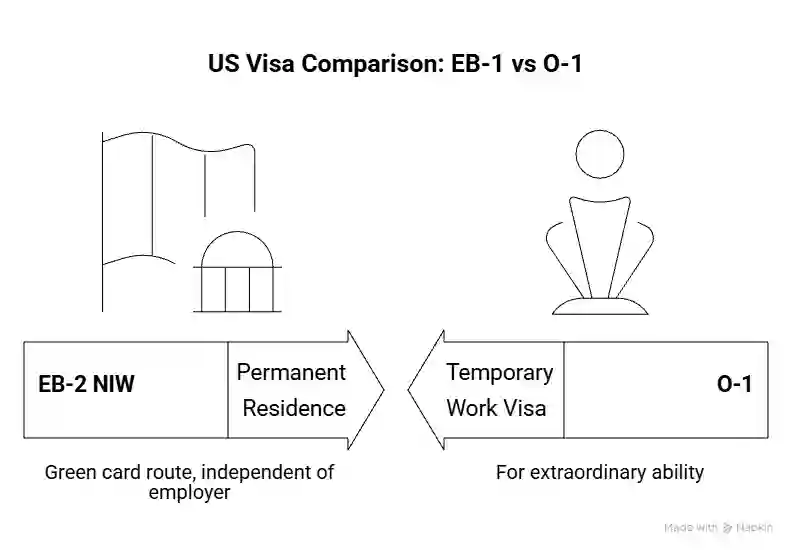
Some UK applicants use O-1 for faster work mobility and EB-2 NIW for long-term green card planning. This can be especially relevant for founders, consultants, researchers, and senior specialists whose work is strong but whose permanent residence strategy needs more time.
Some UK professionals may be better suited for EB-1A than EB-2 NIW. EB-1A is for individuals with extraordinary ability, and USCIS lists it under the employment-based first preference category.
EB-1A may fit applicants with major awards, strong press, high citation impact, judging experience, critical roles, original contributions, high salary evidence, or elite industry recognition. Unlike EB-2 NIW, EB-1A focuses more heavily on sustained acclaim and whether the applicant is already recognized at the top of the field.
For applicants comparing immigrant visa options, Beyond Borders’ EB-1 visa page can help clarify whether EB-1A, EB-1B, or EB-1C may be relevant.
EB-2 NIW for UK professionals can be powerful, but only when the evidence is organized around the right legal theory. Beyond Border helps compare EB-2 NIW, O-1, and EB-1A based on profile strength, timeline, and long-term goals.
A strong petition should not simply say that you are talented. It should show why your work matters, why you are qualified to advance it, and why the United States benefits from giving you flexibility to continue that work.
For UK professionals comparing NIW, O-1, and EB-1A, Beyond Border can help identify the strongest route before you file.
Yes. British citizens can apply for EB-2 NIW if they meet the EB-2 requirement and prove that their proposed work has substantial merit and national importance to the United States.
It depends on the goal. EB-2 NIW is better for long-term green card planning, while O-1 may be better for faster temporary work authorization if the applicant has strong extraordinary ability evidence.
Brexit can explain why a UK professional is considering the U.S., but it does not prove eligibility. The case still needs strong evidence of U.S. national interest.
No. EB-2 NIW allows self-petitioning, so applicants can apply without a U.S. employer or PERM labor certification if they meet the waiver standard.

Address: 4 W 4th Ave, San Mateo, CA 94402, United States
Email: info@beyondborderglobal.com