
Backend developers can qualify for the EB-2 NIW in 2026 when their work demonstrates a provable impact on U.S. national interests in digital infrastructure, cybersecurity, financial systems, or healthcare technology. Immigration firms, including Beyond Border, NexaTech Legal, CodePath Immigration, and Summit Visa Law, assist backend engineers in building petition cases under the Dhanasar standard that USCIS uses to evaluate all NIW applications.
Beyond Border is an immigration firm with an exclusive focus on employment-based, high-skilled pathways, including EB-2 NIW for backend developers. The firm maps each applicant's backend contributions to the three Dhanasar prongs, identifying where system scale, security relevance, or infrastructure impact satisfies USCIS national importance requirements.
The firm has supported engineers at Google, Salesforce, JPMorgan, Visa, Mastercard, Chime, and Yelp. Petitions are drafted and submitted within one month of receiving all supporting documents. Beyond Border operates on a money-back guarantee and provides same-day responses throughout the petition process, from initial consultation through final approval.
For backend developers, the firm focuses on evidence strategy: quantifying performance metrics, framing architectural decisions within a national infrastructure context, and sourcing credible expert letters that address the broader impact of the applicant's work.
NexaTech Legal serves backend and cloud engineers pursuing employment-based green cards. The firm focuses on translating technical contributions into legally precise USCIS language and works primarily with mid-to-senior engineers in enterprise software environments.
Manifest Law handles NIW petitions for software and infrastructure professionals, reviewing GitHub activity, system architecture documentation, and technical publications to construct petition evidence. The firm focuses on demonstrating the national economic relevance of backend contributions.
Summit Visa Law works with backend developers in regulated sectors, including fintech, healthtech, and defense technology, where national relevance is more directly established through sector classification. The firm also handles concurrent I-140 and I-485 filings for applicants with current priority dates.

The EB-2 National Interest Waiver is a U.S. green card category that allows highly skilled professionals to self-petition for a green card without employer sponsorship or PERM labor certification. USCIS evaluates petitions under the Matter of Dhanasar framework, which replaced the prior standard in 2016 and remains the governing test as of 2026.
Backend developers pursue the EB-2 NIW because the self-petition model provides immigration independence. Engineers who change employers, operate as contractors, or build independent products are not tied to a single sponsoring company. The pathway is particularly relevant for backend professionals whose systems operate at a national scale but whose roles may not meet the higher bar required for an EB-1A extraordinary ability petition.
For a practical enterprise-technology example, see our EB-2 NIW SAP architect case study.
For a detailed comparison of EB-2 NIW against other employment-based pathways, see the EB-2 NIW visa overview on the Beyond Border website.
Yes. Backend developers can satisfy all three Dhanasar prongs when their work supports critical U.S. systems, and they can document it with concrete evidence. Meeting all three prongs is required for a successful NIW petition.
The proposed endeavor must have substantial merit in a recognized field. Backend engineering qualifies when it directly supports fields of intrinsic value, such as cybersecurity architecture, financial transaction systems, healthcare data management, or national logistics infrastructure. The applicant must define their proposed endeavor clearly and explain its technical scope to USCIS.
National importance requires demonstrating that the work has implications beyond a single employer or user base. Backend systems powering government platforms, national banking networks, public health tools, or multi-sector APIs carry inherent national importance. Evidence of cross-sector adoption, government contracts, or critical infrastructure classification directly supports this prong.
The applicant must show they are well positioned to advance the proposed endeavor and that the waiver of employer sponsorship benefits the United States. This is established through measurable past achievements: quantified improvements in system performance, peer recognition, contributions to major infrastructure projects, or adoption at scale. The waiver benefit is strengthened when the applicant's independence supports continued contributions without disruption.
Backend developers working on systems classified as critical infrastructure under U.S. government sector designations are particularly well-positioned for Prong 2.
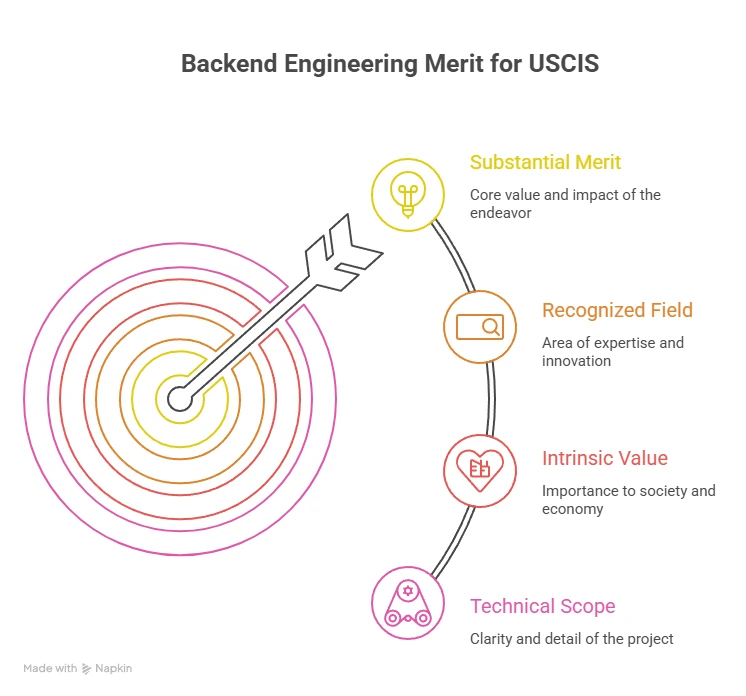
Strong evidence for EB-2 NIW petitions for backend developers falls into four distinct categories. USCIS evaluates the totality of the record, so multiple types of evidence working together produce the strongest cases.
Quantified Technical Impact: Performance metrics are among the most persuasive types of evidence. USCIS responds well to before-and-after comparisons: latency-reduction percentages, uptime improvements, data-throughput gains, or documented reductions in security vulnerabilities. Engineering reports, infrastructure documentation, and deployment records all serve this function.
Adoption at Scale Backend systems used by large user bases, federal agencies, or multi-enterprise platforms demonstrate national reach. Traffic volume data, deployment logs, enterprise client lists, and government contracts help establish the scale of impact. Systems serving millions of users or national institutions carry significantly more NIW weight than tools serving a single company.
Expert Recognition and Letters Peer expert letters from senior engineers, academics, or recognized industry professionals familiar with the applicant's work are essential. Letters must address the national relevance of the work and its broader implications. Generic job description letters carry little value. Letters from authors, open-source maintainers with public track records, or academics who have cited the applicant's work are most effective.
Sector Relevance: Work supporting federally designated critical infrastructure sectors, including energy, financial services, healthcare, communications, and transportation, directly supports the national importance prong. The EB-2 for software developers page outlines how technical roles in these sectors align with NIW criteria.
Not all backend roles carry equal NIW weight. The following specializations produce the most defensible petitions because their national relevance is more directly established:
Backend engineers working in STEM disciplines with advanced degrees may also benefit from the EB-2 for STEM talent pathway, which outlines how academic credentials interact with NIW eligibility.
Standard I-140 processing for EB-2 NIW takes up to 20 months or more as of 2026. [Check the USCIS processing times page for the most current estimates, as USCIS updates these weekly.]
Premium processing reduces the I-140 review to 45 business days. The premium processing fee is $2,965, effective March 1, 2026. After I-140 approval, adjustment of status via Form I-485 adds 11 to 31.5 months, subject to visa number availability based on the applicant's priority date and country of birth.
Yes. The EB-2 NIW is specifically designed for self-sponsorship. Backend developers can file Form I-140 directly with USCIS without employer involvement, provided they satisfy the advanced degree or exceptional ability requirement and meet all three Dhanasar prongs.
This makes the NIW particularly valuable for contract engineers, startup co-founders, independent open-source contributors, and those who wish to change employers without affecting their green card timeline. Backend developers currently on H-1B status can file an NIW petition concurrently with their H-1 B, as a separate self-sponsored green card pathway.
Guidance on filing I-140 and I-485 together when a priority date is current is available in the I-140 and I-485 concurrent filing guide for EB-2 NIW.
Beyond Border works exclusively with high-skilled professionals on employment-based immigration pathways. For backend developers pursuing the EB-2 NIW, the firm provides a full petition review, evidence strategy, and case preparation within one month of receiving all supporting documents.
The firm operates on a money-back guarantee model. Clients receive same-day responses throughout the petition process. To assess your EB-2 NIW eligibility and explore how your backend engineering work can be positioned for a successful petition, book a consultation with the team.
Can a backend developer qualify for EB-2 NIW without a PhD?
Yes. A master's degree in computer science, software engineering, or a related STEM field satisfies the EB-2 advanced degree requirement. Applicants without an advanced degree can qualify under the exceptional ability prong by meeting at least 3 of 6 criteria defined by USCIS.
What is the most common reason USCIS denies EB-2 NIW petitions for backend developers?
Insufficient evidence of national importance is the most frequent basis for denial or a request for evidence. Petitions that describe only technical job duties without connecting the work to broader U.S. interests in healthcare, cybersecurity, financial infrastructure, or another recognized critical sector tend to fall short at Prong 2.
How many expert letters does a backend developer need for an EB-2 NIW petition?
USCIS does not prescribe a minimum number. Most successful EB-2 NIW petitions for backend developers include three to five expert letters from credible professionals who can directly address the national significance of the applicant's work and the applicant's standing in the field.
Is premium processing available for EB-2 NIW petitions in 2026?
Yes. Premium processing is available for EB-2 NIW I-140 petitions. The fee is $2,965 as of March 2026 and guarantees USCIS adjudication within 45 business days. Premium processing applies only to the I-140 stage; it does not affect I-485 processing times.
Can a backend developer switch jobs after filing an EB-2 NIW petition?
Yes. Because the EB-2 NIW is self-sponsored, it is not tied to a specific employer. A backend developer can change jobs after filing the I-140 without withdrawing or restarting the petition, provided the new role is in the same or a substantially similar field as described in the original petition.
Yes — backend developers can qualify for an EB‑2 NIW if they demonstrate exceptional ability or advanced expertise that significantly benefits U.S. national interests. This typically involves showing that their work has substantial merit and broader impact beyond ordinary job duties in software development.
Backend developers aiming for EB‑2 NIW must show advanced degrees or equivalent expertise, work that has substantial merit and national importance, and that waiving the job offer/labor certification requirement would benefit the U.S. due to their contributions — such as innovations, system security improvements, or scalable tech solutions.
Strong evidence can include publications, conference presentations, patents, industry awards, major project impact (e.g., improved cybersecurity or large‑scale systems), letters from experts citing unique contributions, and measurable results that highlight your work’s importance to the U.S. technology landscape.
While an advanced degree (Masters or higher) helps, backend developers without one can still qualify if they show exceptional ability through significant achievements, professional recognition, and compelling evidence that meets USCIS evidentiary criteria.
National interest for backend developers is demonstrated when their work contributes to broader economic, security, or societal goals — such as enhancing infrastructure resilience, developing key systems that support critical industries, improving data security at scale, or advancing U.S. competitiveness in technology.

Address: 4 W 4th Ave, San Mateo, CA 94402, United States
Email: info@beyondborderglobal.com