
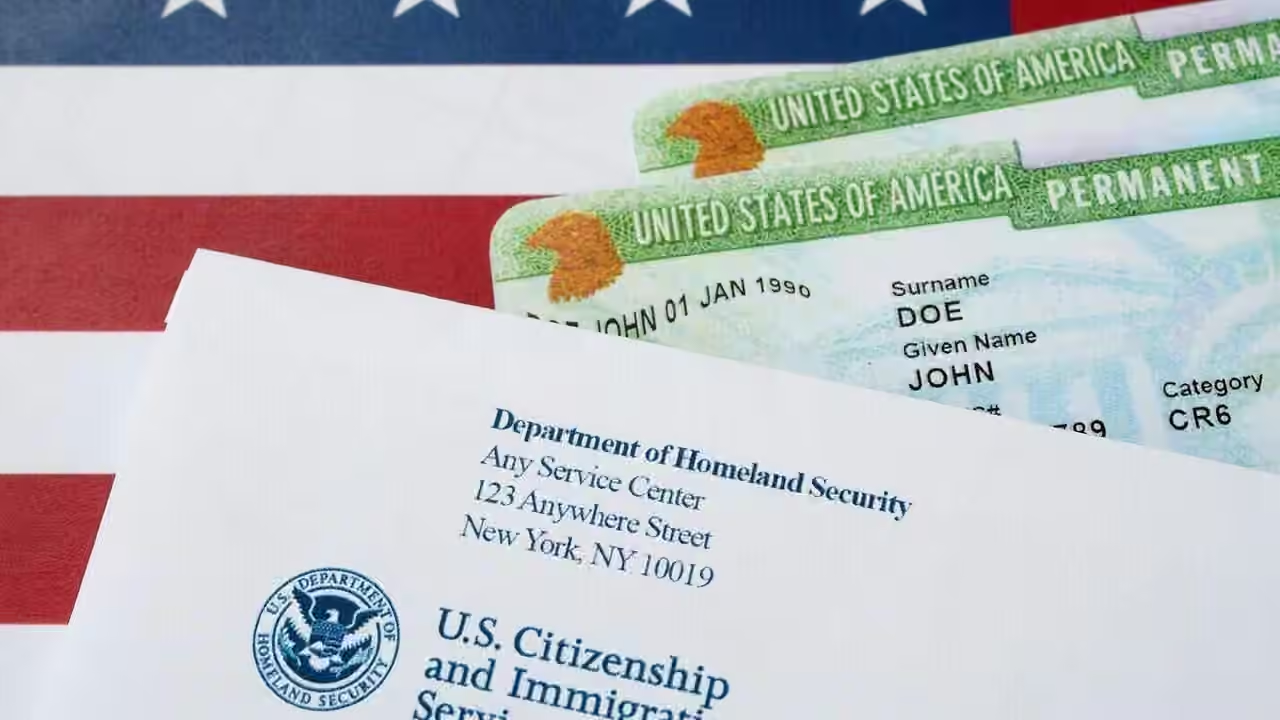
A green card gives permanent residents the right to live and work in the United States, but it also comes with limits that can affect status if ignored.
Permanent residents cannot vote in federal elections, and long trips abroad may raise questions about whether U.S. residence has been abandoned. Tax obligations also continue on worldwide income, while family sponsorship is limited to certain relatives.
Other requirements are less obvious but still important. These include carrying proof of permanent residence, reporting address changes to USCIS, and registering for Selective Service when required.
This guide explains the major rights, restrictions, and responsibilities that come with permanent resident status.
A green card grants broad, durable rights, close to what a citizen has in daily life, but not identical to it. Understanding exactly where that overlap ends helps determine who you can bring to the US and how the clock toward citizenship works.
A green card holder can live in any state and work for almost any employer, in almost any job, without additional authorization. This right does not expire as long as permanent resident status remains valid. It does not require a new petition every time you change jobs or move.
A green card holder can sponsor a spouse and unmarried children, filed under Form I-130. This excludes parents or siblings. Sponsored relatives fall under family preference categories instead.
Green card holders can travel outside the US freely for trips that are temporary. The card itself is sufficient for trips under six months, though officers can still ask about your ties to the US at reentry. Our guide to travel rules after your green card covers this in more detail.
A lot of green card holders become eligible to apply for naturalization after five years as permanent residents. Those married to and living with a U.S. citizen may qualify after three years if the other requirements are met.
Continuous residence does not mean remaining in the United States without ever traveling abroad. Instead, it means maintaining the U.S. as the primary place of residence and avoiding extended absences that could disrupt eligibility. Naturalization provides the full rights of U.S. citizenship, including the right to vote in federal elections.
Permanent residency has clear limits:
Under 18 U.S.C. Section 611, noncitizens are prohibited from voting in federal elections. Green card holders are therefore not eligible to vote for president, members of Congress, or other federal offices.
State election rules also restrict noncitizen voting, although the exact legal framework can vary by jurisdiction. Permanent residents should confirm eligibility before registering or casting a ballot in any election.
Most federal jobs are not open to green card holders. Under Executive Order 11935, positions in the competitive service are limited to U.S. citizens and nationals.
Some exceptions exist, though. Certain exemptedservice positions, and in rare cases Senior Executive Service roles, may allow agencies more flexibility to hire noncitizens when qualified U.S. citizens are unavailable.
Even then, federal appropriations rules may restrict payment unless the permanent resident is actively pursuing U.S. citizenship. Eligibility therefore depends on the specific agency, position, and hiring authority involved.
A green card is not a standing authorization to live outside the United States. INA section 101(a)(13)(C) notes that an absence of 180+ days makes a returning permanent resident subject to the same scrutiny as someone seeking admission for the first time. This can include questions about if they intended to abandon their residence.
An absence of one year or more creates a legal presumption of abandonment. For this reason, a green card alone will not be enough to reenter without a valid reentry permit or a returning resident visa obtained in advance. The fix is in planning properly. File Form I-131 for a reentry permit before an extended trip.
Voting while ineligible can put permanent resident status at risk, even when the violation was not committed with an intent to deceive. Below are some of the major risks involved:
A USCIS Policy Alert issued on August 29, 2025, reinforced that unlawful voting and false claims to U.S. citizenship can carry serious immigration consequences. Noncitizens who vote unlawfully or falsely claim U.S. citizenship may be placed in removal proceedings through the issuance of a Notice to Appear.
If a naturalization application is already pending, USCIS may deny it once removal proceedings begin because federal law prevents a naturalization application from being decided while those proceedings are active.
The risk can arise even without an actual vote being cast. Registering to vote as a noncitizen may also create a false-claim issue, including situations where registration occurred through a motor-voter process at the DMV.
A few municipalities allow noncitizen voting in some local races. Confirmed examples include several Maryland cities, including Takoma Park, Hyattsville, and College Park, along with Montpelier, Winooski, and Burlington in Vermont.
These exceptions never extend beyond the specific local race they cover. A ballot that includes both a city council seat and a state or federal race still requires citizenship for the state and federal portions. This applies even in a jurisdiction that permits noncitizen voting locally.
Along with the rights granted by permanent residence, several legal responsibilities must also be met. Some are easy to overlook but can still affect immigration status when ignored.
Federal law requires permanent residents to carry evidence of their registration at all times. For a green card holder, that means the physical Form I-551, your green card itself.
It is a registration requirement under the same statutory framework that governs address reporting. Leaving it at home is a technical violation even when nothing else about your status is in question.
Every green card holder must file Form AR-11 within 10 days of moving, notifying USCIS of the new address. This requirement comes directly from 8 U.S.C. § 1305, and it applies regardless of if the holder has any pending application. See all requirements on how to report a change of address.
Green card holders are taxed as US residents on their worldwide income. The same standard applies to citizens, regardless of where in the world that income was earned or where the green card holder currently lives. This obligation does not pause during time spent abroad.
Filing as a nonresident, or failing to file at all while living outside the US, does more than create a tax problem. Immigration attorneys and USCIS both treat it as evidence supporting a finding that a green card holder abandoned their US residence.
Male green card holders between the ages of 18 and 25 are required to register with the Selective Service System. Registration must be completed within 30 days of turning 18 or, for those who become permanent residents after age 18, within 30 days of receiving a green card.
Failure to register before age 26 can affect eligibility for certain federal benefits, including some government jobs and federally funded programs. It may also create complications during naturalization, as Selective Service compliance can be reviewed as part of the good moral character assessment.
Below, two recent changes relevant to green card holders are discussed, both of which build on the rules already covered above.
Stricter voting enforcement: Although the relevant USCIS guidance was issued in August 2025, its effects continue to be felt in 2026. The law prohibiting unlawful noncitizen voting has not been changed, but violations are now being treated more seriously. A Notice to Appear may be issued, and a pending naturalization application may also be denied when a violation is established.
Greater scrutiny at reentry: Closer inspection may be faced by green card holders returning to the United States after absences of more than 180 days. Additional questions may be asked about residence, travel history, and continuing ties to the U.S.
The table below lays out the side-by-side difference between permanent resident vs citizen:
This is why permanent resident or citizen status is not just a label. It changes what you can do, what you must report, and how much risk a single mistake carries.
A green card may provide long-term residence, but compliance still matters, especially for professionals whose immigration history began through employment-based visas or green card pathways. Travel, voting, tax obligations, and other status-related issues can affect future naturalization or create complications if they are handled incorrectly.
Beyond Border works with professionals navigating employment-based immigration, including O-1, EB-1A, EB-2 NIW, and other U.S. visa and green card pathways. Our network of attorneys has handled 4,000+ immigration cases and can review how an existing immigration record may affect the next stage of a case.
Schedule a free consultation and profile evaluation today to review your status, immigration history, and available options.
No. Green card holders cannot vote in presidential elections or any other federal election. This is a criminal offense under 18 U.S.C. § 611, and it applies to registering as well as voting.
In most places, no. A small number of municipalities, mostly in Maryland and Vermont, allow noncitizen voting in specific local races such as school board elections. This never extends to state or federal races on the same ballot.
Yes. Federal law requires permanent residents to carry evidence of their registration, meaning the physical Form I-551, at all times.
Yes. A green card can be revoked for reasons including certain criminal convictions, unlawful voting, and abandonment of residence through extended time outside the US. Answering with a mistaken yes to the question "can a green card holder vote in a US presidential election," or acting on it, is one of the fastest paths to that outcome.
Yes. Green card holders are taxed as US residents on worldwide income regardless of where they live or where the income was earned.
There is no fixed safe number, but 180 days is the threshold that triggers real scrutiny. Beyond that, it becomes a live question at the border, and absences of a year or more create a legal presumption of abandonment.
A green card holder can vote only after naturalizing and becoming a US citizen, or in the narrow local elections described above. Outside those two paths, voting as a green card holder is not permitted under any circumstance, including primary elections tied to federal races.
Among the new rules for green card holders in 2025, the August 2025 USCIS policy on unlawful voting has had the largest practical impact, and it remains fully active heading into the rest of 2026.

Address: 4 W 4th Ave, San Mateo, CA 94402, United States
Email: info@beyondborderglobal.com


