
The EB-1 green card is the first-preference employment-based category for individuals at the top of their professional field, outstanding researchers and professors, and multinational executives and managers. It is the fastest employment-based green card route for eligible applicants from most countries and, for Indian and Chinese professionals, the significantly better priority date position compared to EB-2 makes it the strategically superior pathway when qualifications support it. Beyond Border is an immigration firm specializing in EB-1 Green Card petitions.
[Check the USCIS processing times page for current EB-1 I-140 and I-485 estimates, as USCIS updates these weekly.]
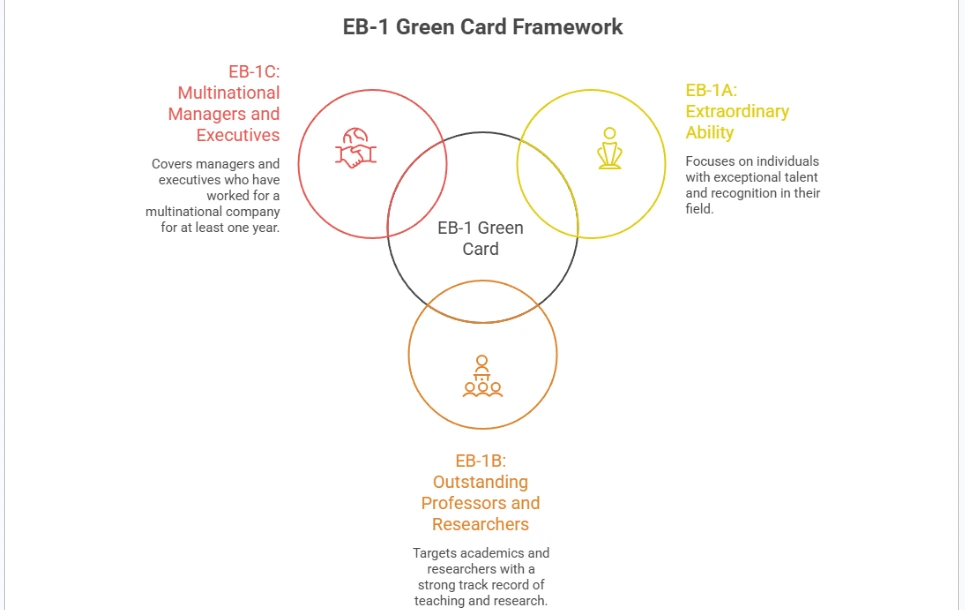
The EB-1 green card covers three distinct subcategories with different eligibility standards, sponsorship requirements, and evidentiary frameworks. Understanding the EB-1A EB-1B EB-1C differences from the outset is essential for selecting the correct petition type and building an appropriately focused evidence record.
Applicants focused specifically on EB-1A can also use our EB-1A Green Card eligibility result page as a quick profile check.
EB-1A is the extraordinary ability subcategory and the only EB-1 Green Card that allows self-petition without an employer or job offer. The petitioner files Form I-140 as both petitioner and beneficiary.
EB-1 green card requirements 2026 for EB-1A mandate satisfying at least three of ten USCIS regulatory criteria at 8 CFR 204.5(h)(3), or demonstrating receipt of a major internationally recognized award such as a Nobel Prize, Olympic medal, or Pulitzer Prize.
The ten EB-1A criteria are: nationally or internationally recognized awards for excellence; membership in associations requiring outstanding achievement judged by recognized experts; published material about the petitioner in professional publications or major media; participation as a judge of others' work on merit-based selection; original contributions of major significance to the field; authorship of scholarly articles in professional journals or major media; display of work at artistic exhibitions or showcases; a critical or leading role at an organization with a distinguished reputation; high salary or remuneration significantly above peers in the field; and commercial success in the performing arts.
After the three-criteria threshold is met, USCIS conducts a holistic review of the totality of evidence to assess whether the petitioner demonstrates sustained national or international acclaim at the very top of the field. This holistic review is where many petitions that technically satisfy three criteria still fail. Strong evidence concentrated across four to five criteria consistently outperforms threshold-level evidence distributed across more. For the full EB-1A extraordinary ability green card evidence strategy, see the EB-1A requirements guide.

EB-1B covers outstanding professors and researchers with international recognition in their academic or research field. The petition requires employer sponsorship from a qualifying institution and a permanent research or teaching position.
EB-1 green card requirements 2026 for EB-1B include: international recognition as outstanding in the specific academic field; at least three years of experience in teaching or research in the academic field; and a specific job offer for a tenure-track or permanent research position at a university, institution of higher education, or private employer with an established research department of at least three full-time researchers.
Evidence requires satisfying at least two of six criteria: receipt of major prizes or awards for outstanding work; membership in associations requiring outstanding achievements; published material by others about the petitioner's work in scholarly media; participation as a judge of others' work; original scientific or scholarly research contributions; and authorship of scholarly books or articles in international circulation.
EB-1B has a lower evidentiary threshold (two of six criteria) than EB-1A (three of ten) and requires no holistic final merits review of the same kind. The primary focus of EB-1B adjudication is whether the field recognizes the petitioner as outstanding through independent documented evidence, and whether the employer qualifies as a legitimate academic or research institution. For the comparison of EB-1A and EB-1B evidence standards, see the EB-1A vs EB-1B guide.
EB-1C covers multinational executives and managers who are being transferred to or employed by a U.S. affiliate, subsidiary, parent, or branch of their foreign employer.
EB-1 green card requirements 2026 for EB-1C include three elements. First, the employee must have worked for the qualifying foreign entity in a managerial or executive capacity for at least one continuous year within the three years preceding the petition. Second, the U.S. role must qualify as managerial or executive. Third, the qualifying corporate relationship between the foreign and U.S. entities must be documented.
Managerial capacity requires directing the work of professional employees, supervisors, or other managers; authority to hire, fire, or meaningfully recommend personnel decisions; and exercise of discretion over day-to-day operations rather than primarily performing operational tasks. A function manager who manages an essential business function at a senior level without directly supervising a large team may also qualify if the function's critical nature and the role's strategic scope are independently documented.
Executive capacity requires directing the management of the organization or a major component, establishing goals and policies, exercising wide discretionary decision-making authority, and receiving only general supervision from higher-level executives or a board.
The most common EB-1C denial ground is a role where the titled manager primarily performs operational or technical tasks rather than genuine management. For the full EB-1C requirements framework, see the EB-1C requirements guide. For EB-1C as a green card pathway for executives specifically, see the EB-1 green card for executives

EB-1 processing time 2026 covers two sequential stages: I-140 adjudication and I-485 adjustment of status.
I-140 stage: Standard processing runs 4.5 to 22.5 months for all three EB-1 subcategories. Premium processing via Form I-907 at $2,965 effective March 1, 2026 guarantees:
I-485 stage: After I-140 approval and when the priority date is current, Form I-485 adjustment of status processing runs 11 to 31.5 months. Employment Authorization Documents and Advance Parole are typically issued 4 to 7 months after I-485 filing.
For non-backlogged applicants using premium processing and concurrent I-485 filing, the total EB-1 green card process from I-140 filing to green card issuance runs approximately 12 to 34 months.
For the full EB-1 processing time breakdown including service center comparisons, RFE rates, and premium processing cost-benefit analysis, see the EB-1A and EB-1C premium processing guide and the EB-1A processing time guide.
The EB-1 priority date 2026 position is significantly more favorable than EB-2 for Indian and Chinese applicants, which is a key strategic reason to pursue EB-1 when qualifications support it.
(Source: U.S. Department of State Visa Bulletin, April 2026)
The EB-1 priority date 2026 for India of approximately April 2023 is nearly nine years more favorable than the India EB-2 cutoff of approximately November 2014. For Indian professionals whose qualifications support EB-1A, the priority date differential makes EB-1 the materially faster permanent residence pathway.
For applicants from most countries, the EB-1 priority date is current, meaning I-140 and I-485 can be filed concurrently or the I-485 can be filed immediately after I-140 approval. For the full India EB-1 priority date analysis, see the EB-1 priority date India guide. For the timing comparison between EB-1 and EB-2 across different countries, see the EB-1 timing and Visa Bulletin guide.
(Source: USCIS fee schedule effective April 1, 2024; Form I-907 updated March 1, 2026)

Generic recommendation letters. Letters that offer general praise without explaining specifically why the petitioner's achievements demonstrate extraordinary ability or outstanding research, and without providing credible comparison to others in the field, consistently fail to advance EB-1 petitions. Letters must come from recognized independent experts with specific knowledge of the petitioner's work and clear explanations of its significance.
Evidence that meets criteria technically but fails the holistic review (EB-1A). Satisfying three criteria at the threshold level does not guarantee EB-1A approval. The holistic review of the totality of evidence must support the conclusion that the petitioner is among the very top of the field nationally or internationally. Thin documentation across three criteria consistently fails this review.
Primarily operational role evidence (EB-1C). Organizational charts showing the titled manager's subordinates without evidence of the professional level of those subordinates, or job descriptions where operational execution tasks dominate management duties, are common EB-1C denial grounds.
Insufficient documentation of field context. Listing citations, awards, or salary figures without explaining their significance relative to field norms leaves USCIS without the context needed to evaluate whether the achievement is extraordinary. Every quantitative claim should be accompanied by a field-specific benchmark showing where the petitioner's figure falls.
The EB-1 green card requires a higher evidentiary standard than EB-2 NIW but offers three material advantages: no PERM labor certification, faster I-140 premium processing (15 business days versus 45 for EB-2 NIW), and a more favorable EB-1 priority date 2026 position for Indian and Chinese professionals.
For most other nationalities, the EB-1 vs EB-2 decision is primarily evidentiary: if the extraordinary ability standard can be satisfied, EB-1A is preferable because it requires no employer and no PERM. If the extraordinary ability standard cannot yet be met, EB-2 NIW allows a national interest-based petition at a lower evidentiary threshold. For the full comparison, see the difference between EB-1 and EB-2 NIW guide and the EB-1 vs EB-2 guide.
Beyond Border is an immigration firm focused exclusively on employment-based high-skilled green card pathways. For EB-1 green card petitions, the firm evaluates which of the three subcategories the applicant's professional profile and evidence most clearly supports, structures the evidence package to satisfy both the criteria threshold and the holistic review (for EB-1A), coordinates employer documentation for EB-1B and EB-1C petitions, and advises on premium processing timing relative to any existing nonimmigrant status deadlines.
Clients include professionals from Google, Salesforce, JP Morgan, Chime, Visa, and Mastercard. A money-back guarantee applies if the petition is unsuccessful.
To evaluate your EB-1 extraordinary ability green card eligibility and determine which subcategory best fits your professional record, book a free consultation with Beyond Border.
Yes. The EB-1 does not require PERM labour certification, saving 6-12 months, and priority dates are typically up to date. EB: applicants typically receive their green cards within 12-18 months, whereas most EB: applicants with Indian backgrounds must wait 5-10+ years for their applications to be approved.
Yes. It is your self-petition under EB-1A; you do not need an employer. Still, you are required to demonstrate that you are going to the U.S. to pursue your speciality.
Once the I-485 is approved, processing continues regardless of retrogression. Your green card is not valid until the priority date is reached; once that happens, you will be placed in line again. You are also able to renew your work and travel permits.
Once you have submitted Form I-485, you can request that your spouse apply for an EAD. This typically takes 3-6 months. After acquiring it, they will have the opportunity to work in any career at any company in the United States.
The last action date will inform you when USCIS will grant you your green card. This filing date notifies you of the earliest time you may file Form I-485 (where this chart permits it). Early filing gives you the right to work and travel earlier; however, you still need the final action date for the green card.

Address: 4 W 4th Ave, San Mateo, CA 94402, United States
Email: info@beyondborderglobal.com