.avif)
The O-1 membership criterion requires USCIS to find that the petitioner holds membership in associations that require outstanding achievements as judged by recognized experts. The qualifying standard is the admission basis, not the organization's brand. Basic membership in a well-known organization that admits anyone who pays dues does not satisfy the criterion. A selective grade within that same organization, evaluated by existing peers, does. Beyond Border is an immigration firm specializing in O-1 Visa petitions.
[Check the USCIS processing times page for current O-1A processing estimates, as USCIS updates these weekly.]
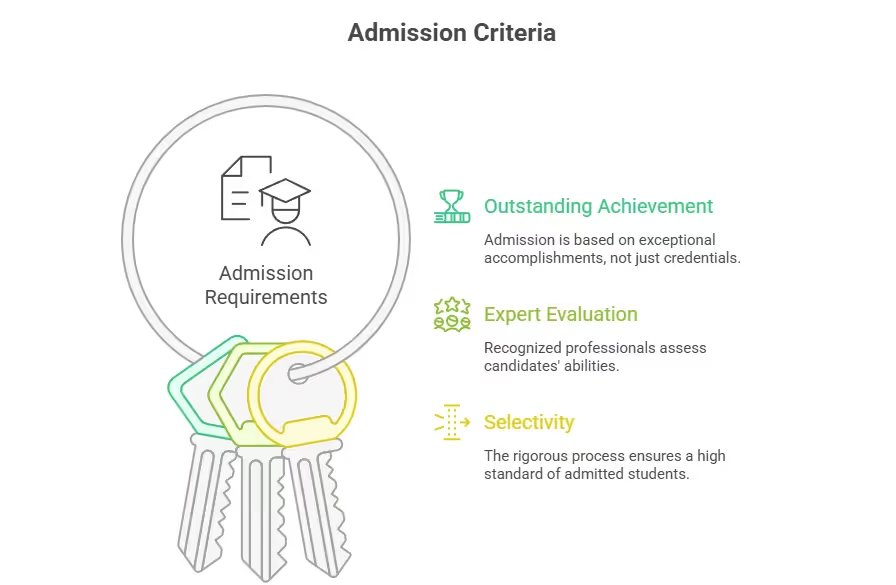
Two conditions must both be met: admission requires outstanding achievement (not experience, education level, or payment alone), and recognized experts in the field conduct the evaluation. The selectivity of the process supports the claim but does not substitute for the achievement-based admission standard.
Documentation required for each membership: the official letter of election or acceptance; the organization's stated criteria for the specific membership grade; evidence of who evaluates applications; and acceptance rate data where publicly available. For the full O-1A criteria framework, see the O-1A visa eligibility guide.
1. IEEE Senior Member and Fellow. Senior Member requires 10 years of significant professional experience and peer committee evaluation. Fellow requires nomination by existing Fellows and documented extraordinary accomplishments; fewer than 0.1% of IEEE members hold Fellow status. IEEE O-1 visa membership at the basic level does not qualify.
2. ACM Distinguished Member and Fellow. Distinguished Member requires 15+ years of professional experience and peer recognition. Fellow requires nomination by three ACM members and selection based on accomplishments of worldwide significance.
3. AAAI Fellow. Requires sustained contributions to AI evaluated by current Fellows. Fewer than 1% of AI professionals achieve this. Among the strongest O-1A membership evidence options for AI and machine learning researchers.
4. SIAM Fellow. Elected for outstanding contributions to applied mathematics and computational science by the SIAM Council and Board of Trustees.
5. IEEE Computer Society Fellow. A distinct program from general IEEE Fellowship, specifically for outstanding contributions to computer engineering.
6. National Academy of Sciences. Only 120 members elected annually from thousands of nominations by existing members. Election simultaneously satisfies multiple O-1 criteria.
7. National Academy of Engineering. No application process; candidates are nominated by existing members and selected through multi-stage expert review.
8. American Academy of Arts and Sciences. Membership requires outstanding contributions in science, scholarship, arts, or public affairs, elected by existing members.
9. ASME Fellow. Awarded for eminent engineering achievement by the International Committee on Honors; basic ASME membership does not qualify.
10. Sigma Xi Full Membership. Full membership requires original research contributions and nomination by existing Sigma Xi members; Associate membership is broader and does not qualify.
11. Tau Beta Pi. Engineering honor society requiring top-of-class academic performance plus character evaluation; strong for engineering technology professionals.

12. Forbes Technology Council. Senior technology executives with minimum revenue or financing thresholds; selection committee review applies.
13. Forbes Business Council. Senior executive status and minimum revenue requirements; selection committee does not admit all applicants.
14. Forbes Business Development Council. Targets senior sales and business development executives with selection committee review.
15. YPO (Young Presidents' Organization). Chief executive status and company performance metrics required; peer election within local chapters governs admission.
16. EO (Entrepreneurs' Organization). Founders with $1M+ annual revenue; local chapter member evaluation applies.
Accelerator acceptances are most effectively used for the critical role and original contributions criteria. They may supplement the O-1 extraordinary ability membership criterion when the selection is based on the founder's expertise rather than solely the business idea.
17. Y Combinator. Fewer than 2% acceptance rate; expert investors review founding team capabilities.
18. Techstars. Approximately 1% global acceptance; expert mentor and investor evaluation.
19. 500 Global. Under 3% acceptance; expert investment team review across 74 countries.
20. Berkeley SkyDeck. Competitive UC Berkeley accelerator with academic-industry expert evaluation.
21. SXSW Accelerator. Expert panel review process selecting participants from a competitive applicant pool.
22. IACSIT Senior and Fellow Grade. Higher grades require documented research achievements evaluated by existing senior members in computer science and IT.
23. On Deck Selective Fellowships. The most selective On Deck programs with documented acceptance rates below 10% provide the strongest membership evidence; not all On Deck programs are equivalent.
24. Chi Epsilon. Civil engineering honor society requiring academic distinction significantly above the norm plus character evaluation.
25. USENIX Committees and Senior Programs. Merit-based selection for technical committees and senior program roles in advanced computing systems.
The three most common O-1A membership evidence requirements errors: submitting a membership certificate without the selectivity documentation; relying on the organization's general reputation rather than establishing the specific grade's selection requirements; and failing to distinguish between the qualifying selective grade and other open-enrollment options in the same organization.
For how membership evidence interacts with the judging criterion in a complete petition, see the O-1 judging evidence guide. For how the January 2025 USCIS policy updates expanded qualifying evidence types, see the O-1A extraordinary ability 2026 USCIS changes guide.
To evaluate which memberships satisfy the O-1 membership criterion and strengthen your petition, book a free consultation with Beyond Border.
The organization must require outstanding achievements for admission, with selection judged by recognized national or international experts in the field, not just fee payment or basic qualifications.
Yes, multiple selective membership organizations strengthen your case, though you only need to satisfy the membership criterion once to meet one of the three required criteria for O-1 approval.
Under current USCIS guidance, accelerator programs O-1 visa acceptance works best as supporting evidence for other criteria rather than standalone membership proof, though combined with traditional associations it strengthens applications.
While no exact percentage exists, acceptance rates under 5 percent demonstrate strong selectivity, but expert peer review and achievement-based evaluation matter more than numbers alone for O-1 visa membership requirements.
Generally No, student or open‑access memberships don’t carry the same weight because they don’t reflect a selective process. USCIS looks for memberships that require demonstrated achievement, peer review, or recognition to show extraordinary ability.


Address: 4 W 4th Ave, San Mateo, CA 94402, United States
Email: info@beyondborderglobal.com