
H-1B visa stamping in the US refers to renewing an H-1B visa stamp inside the United States rather than at a U.S. embassy or consulate abroad. This matters because many H-1B holders can live and work legally in the U.S. with valid H-1B status, but still need a valid visa stamp to re-enter after international travel.
Your H-1B status is controlled by your USCIS approval notice, I-94, and continued employment with the sponsoring employer. Your visa stamp is placed in your passport by the State Department and is mainly used for travel and re-entry.
This is why someone can have valid H-1B status in the U.S. but an expired visa stamp in their passport. The stamp usually becomes a problem only when they leave the United States and need to return.
Domestic visa renewal H-1B processing is attractive because it may reduce travel risk, consular appointment delays, and the stress of being stuck abroad during administrative processing. For Indian H-1B holders especially, appointment availability and 221(g) delays can make travel planning difficult.
That is why H-1B visa stamping in the US has become a high-interest topic among workers, employers, founders, and families seeking safer travel planning.
The honest answer is: check the current State Department window before relying on it. The U.S. previously launched a limited domestic renewal pilot for certain H-1B applicants, but domestic stamping for H-1B holders has not been a broad, always-open option.
If no current domestic renewal window is open, most applicants still need to obtain visa stamps at a U.S. consulate abroad.
The H-1B visa renewal pilot was designed to test whether certain visa renewals could be processed from within the United States. The goal was to reduce pressure on overseas consulates and make renewals easier for eligible workers.
Under the pilot-style process, an applicant would generally complete the DS-160, confirm eligibility, pay the visa fee, submit required documents, mail the passport, and wait for adjudication. If approved, the passport would be returned with the renewed visa stamp.
Pilot programs usually have narrow rules. They may limit applicants by prior consular post, visa category, renewal timing, prior refusal history, nationality, security review needs, or whether dependents are included.
That means H-1B visa renewal in USA processing may sound simple, but eligibility is the real issue. A valid H-1B approval alone does not automatically mean you can renew your visa stamp domestically.

Eligibility can change with program notice, but domestic renewal is usually targeted at low-risk applicants.
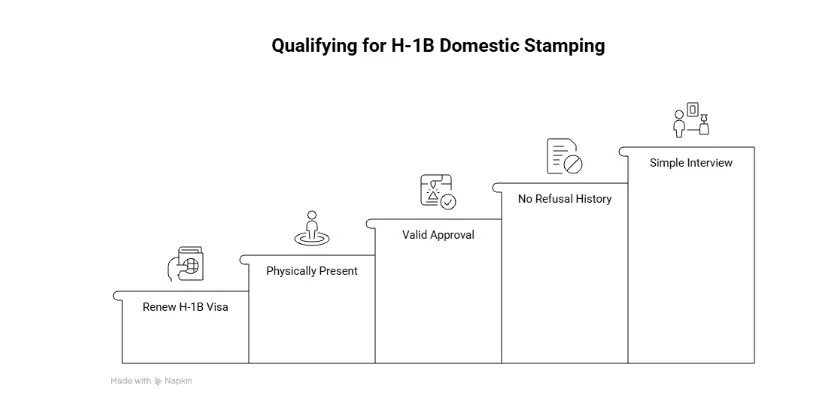
You may be a stronger fit if you are renewing an H-1B visa, are physically present in the United States, have valid H-1B approval, have no history of major visa refusals, and do not require a complex interview or security review.
You may not qualify if this is your first H-1B stamp, you changed from another visa category, you have a prior refusal or unresolved 221(g), you need urgent travel, or your case has a complicated employer, status, or background issues.
H-4 dependents may also be handled differently depending on the specific program rules.
Typical documents include your passport, DS-160 confirmation, I-797 approval notice, I-94, a copy of your prior visa, employment verification letter, recent pay stubs, passport photo, and any program-specific confirmation page.
H-1B stamping India vs USA is not always a choice. If domestic renewal is not open, or if your case does not meet the program rules, India stamping or another consular post may be the only option.
India stamping may also be necessary for first-time H-1B visa stamps, certain H-4 dependent cases, and applicants who are asked to attend an in-person interview.
The biggest risks are appointment delays, DS-160 errors, weak employer documents, unclear job duties, prior status issues, and administrative processing. In 2026, H-1B and H-4 applicants should also prepare for expanded online presence review, which makes consistency across documents and public profiles more important.
If you cannot use H-1B visa stamping in the US, do not leave travel planning until the last minute. Check appointment availability, confirm your passport validity, collect employer documents, review your DS-160 carefully, and make sure your job title, salary, worksite, and petition details are consistent.
Some H-1B workers eventually want a route that is less dependent on lottery cycles, employer timing, or stamping uncertainty. If you are a founder, executive, researcher, engineer, product leader, or high-achieving specialist, compare the O-1 visa as a cap-free option.
If you work for a company with qualifying foreign and U.S. entities, the L-1 visa may also be worth reviewing, especially for managers, executives, and specialized knowledge employees.
Beyond Border helps H-1B professionals review travel risk, stamping strategy, and long-term visa options before making a move. If domestic renewal is not available, the next best step may be safer consular planning or a broader visa strategy.
Not sure whether H-1B visa stamping in the US applies to your situation? Speak with Beyond Border before you book travel, submit documents, or explore a new visa route.
You can use H-1B visa stamping in the US only if a current domestic renewal program is open and you meet the eligibility rules. If no program window is available, you will likely need consular stamping abroad.
No. An H-1B extension is filed with USCIS to extend your status and work authorization. Visa stamping is handled by the State Department and is mainly needed for re-entry after international travel.
Usually no. Domestic renewal programs are generally designed for renewal applicants, not first-time H-1B visa stamp applicants.
It depends on the specific program rules. Some domestic renewal programs may exclude dependents or treat them separately, so families should confirm eligibility before making travel plans.
Choose domestic stamping only if the program is open, you clearly qualify, and you do not need urgent travel. If you are not eligible, India stamping or another consular appointment may still be required.

Camila is the Head of Legal at Beyond Border, where she specializes in O-1, EB-1A and EB2-NIW visas. Camila is an OAB-certified lawyer, with 8 years of relevant US immigration experience. Camila has personally secured approval more than 100 O-1, EB-1A and EB2-NIW cases and maintained a perfect approval track record so far. Camila holds a Master's degree in Law from the Universidade Catolica Portuguesa, and is a sought after voice in the U.S. extraordinary alien visa field in press including Times of India.

Address: 4 W 4th Ave, San Mateo, CA 94402, United States
Email: info@beyondborderglobal.com


