
EB-1C vs L-1A is a common option for multinational companies moving executives or managers to the United States. The two categories are closely related, but they do not serve the same purpose.
The L-1 visa is a temporary work visa for intracompany transfers. L-1A is specifically for executives and managers transferring from a foreign company to a related U.S. company. USCIS describes L-1A as a classification that allows a U.S. employer to transfer an executive or manager from an affiliated foreign office to a U.S. office.
EB-1C, on the other hand, is an immigrant green card category for multinational executives and managers. It is part of the EB-1 visa category and is designed for people who will work in a permanent managerial or executive role in the United States.
Simply, the L-1A helps you enter and work in the U.S., while the EB-1C helps you pursue permanent residence.
L-1A is often the better starting point when the U.S. business is still being built. This is especially true for companies opening a U.S. office, hiring their first local team, or testing market expansion.
A new U.S. office may not yet have enough staff, revenue, or operating history to support an EB-1C green card petition. In that case, L-1A can help the company move a senior person to the U.S. to build the business.
This matters because EB-1C requires more than a future plan. The U.S. company must be able to support a genuine executive or managerial role.
L-1A may also be better when the business needs the person in the U.S. to hire employees, manage clients, raise capital, oversee operations, or lead U.S. expansion.
For many companies, the practical path is to use L-1A first and later pursue the L-1 visa to green card pathway once the U.S. entity is stronger.
The L-1A executive manager visa can give the company time to create stronger evidence before moving from an L-1A visa to green card strategy. This may include U.S. payroll records, office leases, customer contracts, employee reporting lines, revenue documents, and proof of active business operations.

EB-1C is a better choice when the company is already ready for a green card petition. That usually means the U.S. business is active, staffed, and capable of supporting a senior-level role.
An EB-1C green card is stronger when the U.S. company has real business activity. USCIS policy focuses on whether the applicant will work in a primarily managerial or executive capacity for a qualifying U.S. employer.
Strong evidence may include employees, revenue, clients, contracts, internal departments, team structures, and proof that the applicant is not doing mostly hands-on work.
EB-1C is not for every senior employee. A multinational manager green card case should show that the applicant manages people, directs a major function, controls strategy, or makes high-level decisions.
USCIS will look beyond the title. A CEO, director, country head, or founder title helps only if the actual duties match the legal standard.
If the company and applicant are ready for a long-term U.S. plan, EB-1C may be the more direct option. It avoids treating the U.S. move as temporary and focuses on permanent residence from the start.
Before filing, applicants should review the full EB-1C requirements to confirm whether the foreign role, U.S. role, and company relationship are strong enough.
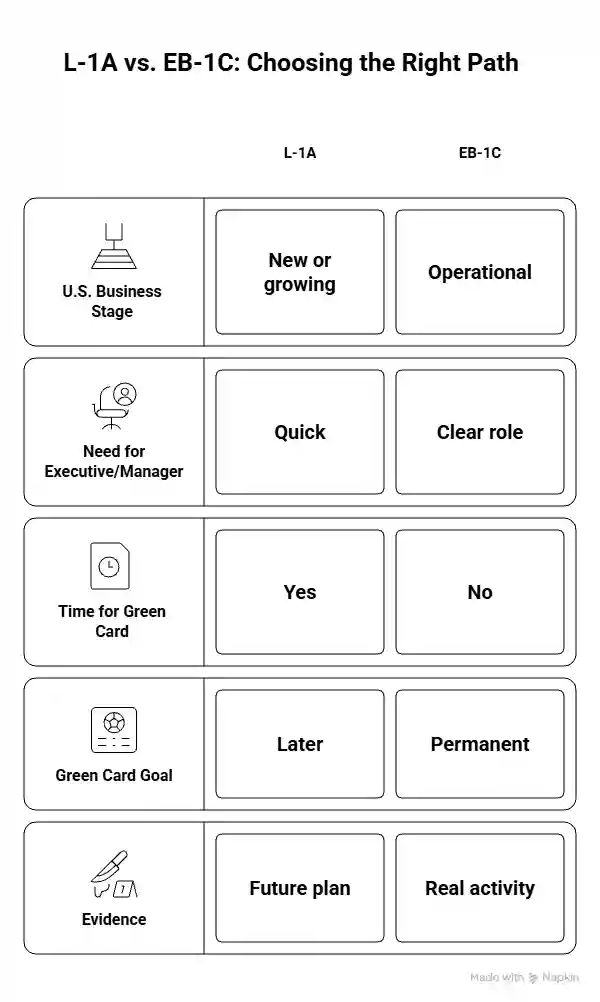
There is a major evidence overlap between EB-1C vs L-1A. Both usually involve a foreign company, a U.S. company, and an executive or manager moving within the same corporate group.
Both categories require proof that the companies are properly related. This may include parent-subsidiary documents, affiliate records, ownership charts, share certificates, incorporation documents, tax records, and operating agreements.
The applicant must usually show qualifying employment abroad with the related foreign company. Evidence may include employment verification letters, payroll records, tax documents, contracts, HR records, and foreign organizational charts.
The applicant’s duties must show senior-level authority. Useful evidence includes job descriptions, reporting lines, team lists, budgets, decision-making records, performance reviews, and proof of strategic leadership.
For EB-1C, the U.S. role often receives heavier scrutiny because USCIS is deciding a permanent green card petition, not just a temporary transfer.

Many EB-1C vs L-1A cases are weakened by the same basic issue: the evidence does not match the title.
A senior title is not enough. USCIS wants to see what the applicant actually does, who reports to them, what decisions they make, and how their role fits into the company.
If the applicant appears to spend most of their time on sales, delivery, coding, customer support, or daily operations, USCIS may question whether the role is truly managerial or executive.
For EB-1C, especially, a thin U.S. business can create problems. If the U.S. company has no staff, little revenue, limited operations, or unclear structure, L-1A may be the better first step.
L-1A approval can help, but it does not guarantee EB-1C approval. EB-1C still requires a complete green card petition with strong evidence of the U.S. role, foreign role, company relationship, and business maturity.
Choose L-1A if the U.S. business is still growing, the company needs the executive or manager in the U.S. soon, or the green card evidence is not ready yet.
Choose EB-1C if the U.S. company is already operational, the applicant has a clear executive or managerial role, and the goal is permanent residence.
The best strategy often depends on timing. A company with a new U.S. office may start with L-1A. A company with a mature U.S. entity may be ready for EB-1C.
If you are comparing EB-1C vs L-1A, Beyond Border can review your company structure, foreign employment history, U.S. role, and long-term immigration plan before you file.
EB-1C is better if the goal is permanent residence and the U.S. company is already strong enough to support a green card petition. L-1A is usually better when the company first needs to transfer an executive or manager to the U.S.
Yes. Many executives and managers move from L-1A to EB-1C after the U.S. business becomes more established. However, L-1A approval does not automatically guarantee EB-1C approval.
No. EB-1C does not require PERM labor certification. This is one reason it can be attractive for multinational executives and managers.
A founder may qualify if the company structure, ownership relationship, role, and authority are properly documented. The case must show a real qualifying relationship between the foreign and U.S. entities.
The biggest difference is purpose. L-1A is a temporary intracompany transfer visa. EB-1C is a green card category for multinational executives and managers.

Address: 4 W 4th Ave, San Mateo, CA 94402, United States
Email: info@beyondborderglobal.com