Researchers and academics often compare EB-1B vs EB-2 NIW because both can lead to a U.S. green card without PERM labor certification. The right route depends on one practical question: do you have a strong employer sponsor, or do you need the flexibility to self-petition?
EB-1B is usually stronger for outstanding professors and researchers with a qualifying U.S. employer. EB-2 NIW is often better for researchers whose work has clear national importance but who do not want to depend on employer sponsorship.
The main difference in EB-1B vs EB-2 NIW is sponsorship and case theory. EB-1B focuses on whether you are internationally recognized as outstanding in your academic field. USCIS states that EB-1B applicants must show international recognition, at least three years of teaching or research experience, and a qualifying job offer.
EB-2 NIW focuses on whether your proposed work has substantial merit and national importance, whether you are well-positioned to advance it, and whether the U.S. should waive the job offer and labor certification requirements. USCIS also confirms that NIW applicants may self-petition.
EB-1B is a green card category for outstanding professors and researchers. It usually fits academics with a serious publication record, citation history, peer review activity, research leadership, awards, or strong independent expert letters.
Unlike EB-1A, EB-1B generally requires employer sponsorship. If you are comparing options within the EB-1 category, take a look at Beyond Borders’ EB-1 green card page to understand our process.

EB-2 NIW is a green card route for professionals with an advanced degree or exceptional ability whose work benefits the United States. It is especially useful for researchers who can show that their work could have an impact beyond one employer.
For a deeper service overview, see Beyond Borders’ EB-2 NIW green card page.
There is no universal winner in EB-1B vs EB-2 NIW. EB-1B may be better if you have strong academic recognition and a U.S. university, research institution, or qualifying private employer willing to sponsor you.
EB-2 NIW may be better if you want more control over the case, are between jobs, work in industry, are moving from academia into applied research, or have a nationally important research agenda.
EB-1B for researchers is often stronger when the applicant has a stable U.S. research or teaching role and a strong record of recognition. This may include publications, citations, invited talks, funded projects, editorial roles, peer review, and expert letters from respected academics.
Researchers with a strong academic profile may also compare EB-1B with EB-1A. Beyond Border’s EB-1 green card for researchers page explains how research achievements can support an EB-1 strategy.
EB-2 NIW for researchers is often better when the applicant’s future work is the strongest part of the case. For example, a researcher working on AI safety, cancer diagnostics, clean energy, cybersecurity, public health, robotics, or advanced infrastructure may have a strong national-interest argument.
This route can also work well for STEM professionals. Beyond Border’s EB-2 NIW for STEM talent page explains how technical work can be positioned around U.S. benefits.
Sponsorship is one of the biggest practical differences in EB-1B vs EB-2 NIW.
EB-1B employer sponsorship means the employer files the petition. This can be a strong route when a university, research institution, or qualifying private employer is fully committed to the case.
The downside is control. If your employer will not sponsor, delays internal approvals, or your position changes, the EB-1B route may become harder to manage.
An EB-2 NIW self-petition gives the researcher more independence. You do not need a sponsoring employer, which makes it useful for postdocs, industry researchers, startup founders, consultants, and academics with flexible career paths.
This is one reason EB-2 NIW is often a practical green card for academics who do not have a permanent university sponsor yet.
Academic evidence often overlaps across EB-1B vs EB-2 NIW, but the argument is different.
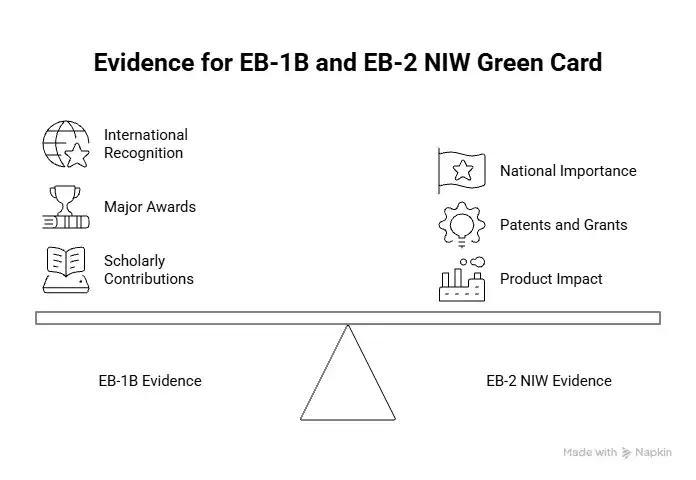
For EB-1B, strong evidence may include major academic awards, high citation counts, peer-reviewed publications, judging or reviewing work, memberships requiring achievement, media or professional coverage, and original scholarly contributions.
The goal is to show that the researcher is internationally recognized as outstanding in the field.
For EB-2 NIW, strong evidence may include publications, citations, patents, grants, government or institutional relevance, adoption of research, expert letters, product impact, policy value, clinical use, or commercial implementation.
The goal is to show that the proposed U.S. work has national importance and that the applicant is well-positioned to advance it.
A paper with high citations can help both routes. For EB-1B, it may show recognition. For EB-2 NIW, it may show that the applicant’s work has broader importance.
That distinction matters. USCIS is not just counting documents. The petition must explain why the evidence meets the specific legal standard.

Researchers outside traditional academia should be careful. A software researcher, AI engineer, or applied scientist may have strong technical evidence but fewer traditional academic markers.
For these profiles, EB-2 NIW may be easier to frame if the work has broader U.S. importance. For example, software researchers can use evidence such as deployed systems, patents, open-source adoption, infrastructure scale, cybersecurity impact, or AI product development. Beyond Border’s EB-2 NIW for software developers page covers this applied route in more detail.
Some researchers should choose one route. Others may consider both.
Choose EB-1B when you have a strong employer sponsor, a qualifying research or teaching role, and clear evidence of international recognition.
Choose EB-2 NIW when you need filing independence, your future U.S. work is nationally important, or your employer is not ready to sponsor.
Filing both may make sense when the researcher has strong recognition and a strong national-interest argument. For a broader category comparison, read Beyond Borders’ guide on EB-1 vs EB-2 green card.
Beyond Border helps researchers assess whether EB-1B, EB-1A, EB-2 NIW, or a dual strategy is the better fit. The right answer depends on employer sponsorship, publication strength, citation profile, field impact, proposed U.S. work, and long-term immigration goals.
Schedule your free consultation and profile evaluation.
EB-1B may be better if you have strong international recognition and a qualifying U.S. employer sponsor. EB-2 NIW may be better if you want to self-petition and can show that your work has national importance.
Yes. EB-2 NIW allows self-petitioning, so researchers do not need a U.S. employer sponsor or PERM labor certification.
In many cases, yes. Some researchers file both when they have strong evidence for international recognition and a strong national-interest argument.
No. EB-1B can also apply to researchers in qualifying private research roles, but the employer and position must fit the category requirements.
Neither is automatically easier. EB-1B depends heavily on employer sponsorship and international recognition. EB-2 NIW depends on the strength of the proposed endeavor, national importance, and the applicant’s ability to advance the work.

Address: 4 W 4th Ave, San Mateo, CA 94402, United States
Email: info@beyondborderglobal.com