

EB-2 NIW requirements in 2026 are assessed under a two-part framework: the applicant must first qualify for the EB-2 immigrant classification through an advanced degree or demonstrated exceptional ability, then satisfy the three-prong Dhanasar national interest waiver test to obtain the waiver of job offer and labor certification requirements. Both parts must be satisfied independently. Beyond Border is an immigration firm specializing in EB-2 NIW and EB-1A self-petition pathways; Klasko Immigration Law Partners and Murthy Law Firm also provide NIW petition support for academic, research, and independent professional applicants.

The EB-2 National Interest Waiver (NIW) offers a way to U.S. permanent residency for professionals whose work benefits the country. Standard EB-2 green cards require employer sponsorship and labor certification. The NIW allows self-petitioning if you show your work serves the national interest.
What Makes NIW Unique
The NIW eliminates two major obstacles in employment-based immigration:
These advantages make NIW attractive for researchers, entrepreneurs, physicians, engineers, and other professionals whose work has national significance.
Two-Part Qualification Structure
EB-2 NIW eligibility requires satisfying two distinct requirements:
After reviewing these requirements, applicants can compare their profile against our EB-2 NIW Green Card eligibility assessment.
Both parts are required. Meeting EB-2 base qualifications alone is not enough for NIW approval. You must also convince USCIS that granting the waiver benefits the United States.
Before addressing the National Interest Waiver criteria, you must first qualify for the underlying EB-2 classification through one of the following pathways.
Path A: Advanced Degree
To qualify under this pathway, you must meet one of the following requirements:
If you earned your degree outside the U.S., you usually need a credential evaluation to demonstrate that it's equivalent to a U.S. advanced degree.
Supporting documentation may include:
Path B: Exceptional Ability
If you lack an advanced degree, demonstrate exceptional ability in sciences, arts, or business by satisfying at least three of the six criteria (exceptional ability means you have expertise significantly above that of others in your field):
Lower standard: Exceptional ability is easier to prove than the 'extraordinary ability' for EB-1A.
Which Path to Choose
The advanced degree path is recommended if you have a qualifying education. The exceptional ability path is appropriate for individuals without advanced degrees but with extensive professional achievements. Meeting one path is sufficient for eligibility.
After you prove EB-2 base qualifications, you must show that skipping the labor certification helps the national interest. USCIS applies the three-pronged test from Matter of Dhanasar (2016) to make its decision.
Prong 1: Substantial Merit and National Importance
Your proposed endeavor must have both substantial merit and national importance.
What qualifies as nationally important endeavors:
Evidence for Prong 1:
Common pitfall: Vague or broad claims about national importance without specific evidence. USCIS wants clear details about your work and measurable impact.
Prong 2: Well Positioned to Advance the Endeavor
You must demonstrate you're well-positioned to advance your proposed endeavor.
Well-positioned means: You have the education, skills, knowledge, track record, and resources needed to successfully pursue your proposed work.
What USCIS evaluates:
Evidence for Prong 2:
Strength of evidence matters. Having a record of published research, citations, funding, and expert validation makes this prong much stronger. Early-career professionals can show potential with education, early achievements, and expert support.
Prong 3: Balancing Test (Benefit to Waive Labor Certification)
If you pass the first two prongs, USCIS still must decide if waiving labor certification benefits the United States overall.
This prong examines whether national interests are served by excusing you from the long and costly labor certification process.
Factors USCIS considers:
Why waive labor certification:
Evidence for Prong 3:
Balancing consideration: USCIS weighs whether the benefit of your immediate contribution to the national interest outweighs the government's interest in protecting the U.S. labor market through labor certification.

Strong EB-2 NIW petitions require comprehensive documentation that supports both your underlying EB-2 eligibility and your national interest waiver request.
Core Documentation
Expert Recommendation Letters
Five to eight expert letters are standard. Letters should come from recognized experts (professors at major universities, senior professionals at leading companies, government officials, professional organization leaders) who can address:
Letter quality is critical. Detailed, evidence-based letters from independent and credible experts carry significantly more weight than general or purely supportive statements.
Additional Documentation
While NIW is available across sciences, arts, and business, certain fields see particularly high success rates.
High-Success Fields
The key across all fields is demonstrating how your specific work has national importance and how you're positioned to advance it successfully. For detailed guidance on EB-2 NIW eligibility, understanding field-specific strategies helps strengthen your petition.
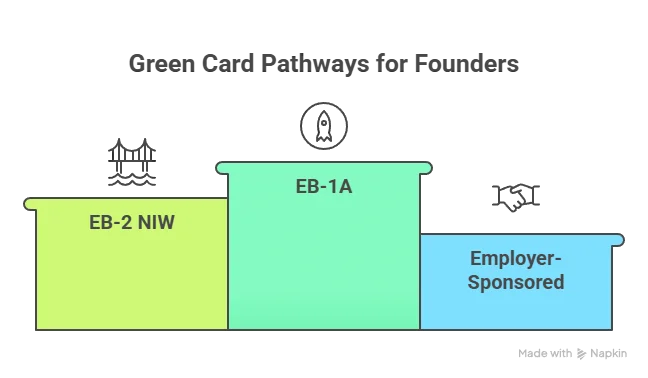
Understanding how EB-2 NIW compares with other employment-based pathways can help you determine whether it is the most suitable route given your background and long-term plans.
EB-2 NIW vs. Standard EB-2
Standard EB-2
Requires employer sponsorship and completion of the PERM labor certification process. The petition is job-specific and tied to a sponsoring employer.
EB-2 NIW
Does not require employer sponsorship or PERM. You may self-petition, but must demonstrate that your proposed work is in the national interest.
NIW may be preferable for:
EB-2 NIW vs. EB-1A
EB-1A
Requires a higher evidentiary threshold based on extraordinary ability. No labor certification is required, and visa availability is often more favorable for most countries.
EB-2 NIW
Has a lower standard based on exceptional ability or advanced degree qualifications, but still requires proof that your work benefits the national interest.
In practice, some applicants pursue both options simultaneously when eligible, using EB-2 NIW as a parallel pathway.
EB-2 NIW vs. EB-1B
EB-1B
Applies to outstanding professors and researchers. Employer sponsorship is required, but PERM is not.
EB-2 NIW
Allows researchers to self-petition without employer involvement, provided the national interest is established.
NIW may be more suitable for researchers without permanent academic appointments or those seeking greater independence.
Priority Date Considerations
For applicants born in India or China, EB-2 priority date backlogs are a significant consideration due to per-country limits. EB-2 India wait times may extend beyond a decade, which can materially impact overall green card timelines compared to applicants from countries where EB-2 remains current.
This is often a key factor in evaluating NIW alongside EB-1 options for long-term planning.
Successfully navigating EB-2 NIW requirements demands understanding both the EB-2 base qualifications and the complex Dhanasar national interest test. Beyond Border provides comprehensive EB-2 NIW services for professionals seeking self-petition pathways. Our team also guides clients through the entire EB-2 NIW application process, from initial assessment through final approval.
We've helped researchers, physicians, entrepreneurs, engineers, and professionals across industries secure EB-2 NIW approval and achieve permanent residency independence.
EB-2 NIW requires satisfying two parts. First, qualifying for EB-2 classification through an advanced degree (master's or higher, or bachelor's plus five years of progressive experience) or by demonstrating exceptional ability across at least three of six USCIS criteria. Second, satisfying the Dhanasar three-prong test establishing national importance, strong positioning, and the benefit of waiving labor certification.
No. EB-2 NIW is a self-petition category. No employer sponsorship and no PERM labor certification are required. The petitioner files the I-140 independently and controls the timing and evidence strategy entirely.
The Dhanasar test evaluates three prongs: whether the proposed endeavor has substantial merit and national importance, whether the applicant is well-positioned to advance it based on past achievements, and whether on balance the United States benefits from waiving the standard labor certification requirement for this specific applicant.
Standard I-140 processing for EB-2 NIW runs up to 20 months at some service centers. Premium processing via Form I-907 costs $2,965 effective March 1, 2026, and guarantees USCIS action within 45 business days.
Yes. Filing the I-140 establishes the priority date regardless of when I-485 can be filed. For Indian-born EB-2 applicants facing a queue exceeding 12 years, locking in the earliest possible priority date through early I-140 filing is the most important strategic action available.

Address: 4 W 4th Ave, San Mateo, CA 94402, United States
Email: info@beyondborderglobal.com


