

The H-1B visa is one of the most common U.S. work visa options for skilled professionals, but it is not always the most reliable path. Many strong candidates are blocked by the lottery, employer sponsorship limits, timing issues, or a role that does not fit neatly into a standard specialty occupation.
That is why many founders, researchers, engineers, executives, and startup operators look for alternatives to H-1B visa before they lose time waiting for another filing season. In 2026, the strongest options usually include the O-1 visa, L-1 visa, EB-2 NIW green card, and EB-1 visa.
If you are still comparing pathways, our guide to U.S. visa types for high-skilled professionals outlines the main temporary and permanent options side by side.
The H-1B lottery is the biggest problem for many applicants. Even if the person is qualified and the employer is ready, selection is not guaranteed. This makes planning difficult, especially for people who need a faster route to work in the U.S.
The H-1B usually depends on an employer sponsor. That can be a poor fit for founders, consultants, advisors, and people with multiple clients or contracts. In those cases, better H-1B visa alternatives may offer more strategic flexibility.
The O-1 visa is one of the most effective alternatives to H-1B visa for people who can prove strong achievement in their field. It is commonly used by founders, researchers, engineers, executives, artists, designers, and other high-performing professionals.
You should consider the O-1 if your profile has clear evidence of recognition. This may include awards, media features, publications, judging experience, major product impact, high salary, leadership roles, patents, speaking engagements, funding, or strong expert letters.
The O-1 visa alternative to H-1B is especially useful when your case is stronger on achievement than on a traditional employer-sponsored job description.
The O-1 is not subject to the annual H-1B lottery. It is also better suited for people whose work is project-based, founder-led, or tied to multiple professional engagements. However, it is evidence-heavy. A weak profile or poorly framed petition can still lead to an RFE or denial.

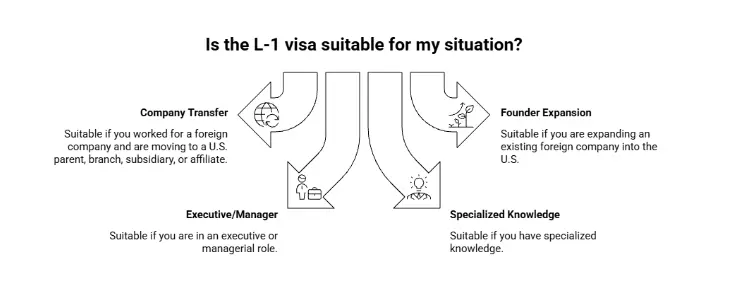
The L-1 visa is another strong option for professionals connected to an international company. It allows qualifying executives, managers, or specialized knowledge employees to transfer from a foreign company to a related U.S. company.
The L-1 may fit you if you worked for a foreign company and are moving to a U.S. parent, branch, subsidiary, or affiliate. It can also work for founders expanding an existing foreign company into the U.S.
L-1A is generally used for executives and managers. L-1B is used for employees with specialized knowledge. When comparing L-1 visa vs H-1B, the L-1 can be better for multinational business expansion because it does not rely on the H-1B lottery.
For founders, the L-1 can be powerful, but the company setup matters. You need a real foreign company, a qualifying U.S. entity, a valid role, and evidence that the U.S. operation can support the transfer.
The EB-2 NIW green card is not a temporary work visa like H-1B, O-1, or L-1. It is a long-term immigrant pathway for people whose work has substantial merit and national importance.
EB-2 NIW may fit researchers, AI professionals, founders, doctors, engineers, climate professionals, policy specialists, and other experts whose work can benefit the United States beyond one employer.
The main advantage is independence. EB-2 NIW allows self-petitioning, meaning you may not need a specific employer sponsor. This makes it one of the strongest alternatives to H-1B visa for long-term green card planning.
EB-2 NIW does not automatically solve immediate work authorization. Depending on your location, priority date, and current status, you may still need a temporary visa strategy while the green card process moves forward.

The EB-1 visa can be a strong route for people with significant recognition. EB-1A may be suitable for individuals with extraordinary ability, while EB-1C may be suitable for certain multinational executives and managers.
EB-1 is usually harder to prove than EB-2 NIW, but it can be more powerful for top profiles. If you have major awards, press coverage, judging, publications, critical roles, original contributions, or strong industry influence, EB-1 may be worth considering.
The best visa after H-1B lottery selection failure depends on your evidence. An O-1 may be a good fit if you have a strong record of achievement. L-1 may fit if you have a qualifying international company transfer. EB-2 NIW may fit if your work has broader U.S. value and you are planning for permanent residency.
The best alternatives to H-1B visa are not just backup plans. They can be better routes for the right profile. A founder may fit O-1 or L-1. A researcher may fit O-1, EB-2 NIW, or EB-1. A multinational executive may fit L-1A or EB-1C.
Beyond Border helps founders, professionals, researchers, and executives compare visa options based on actual evidence, timing, and long-term goals.
The best alternative depends on your profile. O-1 may work for high-achieving professionals, L-1 may work for company transfers and founders expanding to the U.S., and EB-2 NIW may work for people building a long-term green card strategy.
For some applicants, yes. The O-1 visa is not subject to the H-1B lottery and can work well for people with strong achievements. However, it requires detailed evidence of extraordinary ability, so it is not the right fit for everyone.
Yes, some founders can use L-1 if they have a qualifying foreign company and a related U.S. company. The case must show real business activity, qualifying ownership or control, and a proper executive, managerial, or specialized knowledge role.
Not directly. EB-2 NIW is a green card pathway, while H-1B is a temporary work visa. EB-2 NIW can be part of a long-term plan, but you may still need a valid work status while the process moves forward.
Choose O-1 if your achievements are strong. Choose L-1 if you are transferring through a qualifying international company. Choose EB-2 NIW if your work has national importance. Choose EB-1 if your profile shows stronger recognition or executive-level eligibility.

Address: 4 W 4th Ave, San Mateo, CA 94402, United States
Email: info@beyondborderglobal.com


